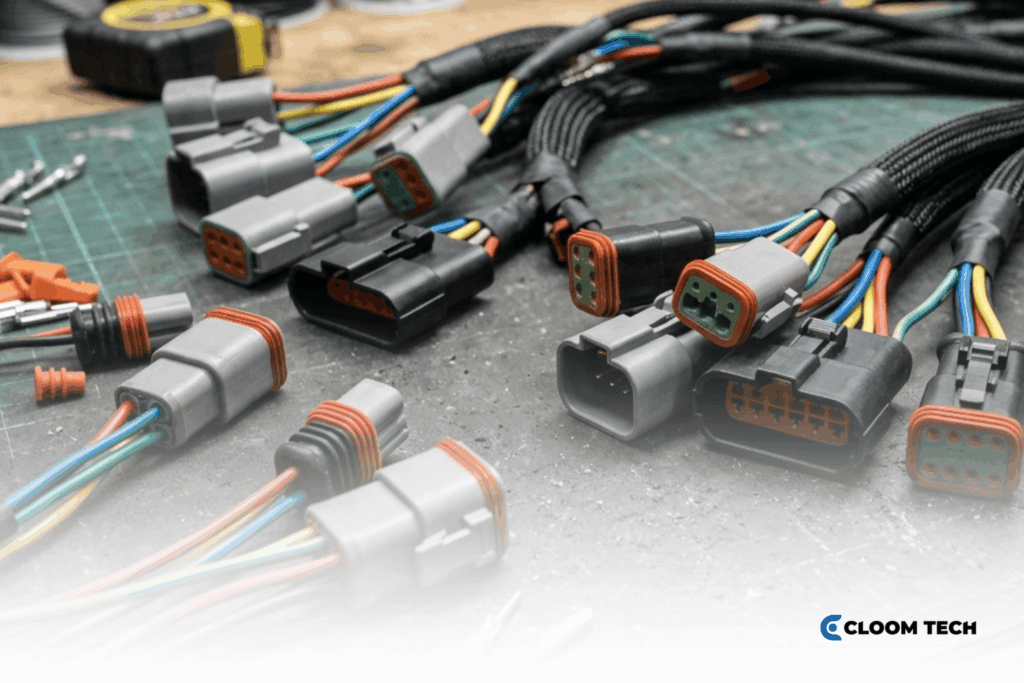
Your choice of Deutsch connector series sets the contact size and current capacity available on each branch of your wire harness. DT handles general-purpose, moderate-current branches, while DTM suits smaller wire where connector space is tight. DTP uses larger contacts for higher-current power branches on equipment exposed to moisture or vibration.
For original equipment manufacturer (OEM) buyers, selection starts with circuit load and the approved wire specification, then moves to installation space and environmental exposure. But Deutsch connectors are only as reliable as their termination, which is why your purchasing specification must pair each housing with compatible contacts and documented wire crimping standards.
What are Deutsch Connectors?
Deutsch connectors are TE Connectivity (TE) connector systems that provide removable, sealed connections for equipment exposed to moisture and vibration. In the DT family, thermoplastic housings and silicone wire and interface seals protect the electrical connection at the mating point.
Inside each housing, molded locking fingers retain the inserted contacts, and a separate wedgelock provides secondary contact retention. The housing latch then holds the two connector halves together, but it doesn’t replace either stage of contact retention.
Deutsch contacts also come in two constructions. Solid (machined) contacts suit heavier-duty and lower-volume work, while stamped and formed contacts are common in higher-volume production. Both fit the same housings, but each needs its own crimp tooling.
Sealing and two-stage retention are the main reasons buyers specify Deutsch connectors in off-highway, agricultural, truck, and marine equipment. Put simply, sealing keeps water, dust, and washdown spray away from the contacts, which prevents corrosion and intermittent faults.
Two-stage retention, from the housing’s locking fingers plus the wedgelock, holds each contact in place so vibration can’t dislodge it. When equipment faces both moisture and vibration, these two features usually matter more than any other connector specification.
Serviceability is another key factor. For components like replaceable sensors, evaluate how easily a technician can disconnect the harness branch in the field.
Deutsch DT Connector Series
A Deutsch DT connector suits general-purpose harness connections, with size 16 contacts rated for up to 13 A per contact. Common inline housings come in six configurations from two to 12 positions, including three-position and eight-position versions.
DT accommodates 14–20 American Wire Gauge (AWG) conductors, with the selected contact defining compatibility for the wire construction. At the rear grommet, the insulation outside diameter must also fit the seal range, not just the conductor gauge.
For wet installations, DT inline connectors carry ingress protection (IP) ratings of IP67 and IP68, while IP6K9K requires rear protection. Before approving pressure-wash exposure, list the compatible backshell or other rear protection in the assembly’s component list. On truck control and agricultural actuator branches, assign each power and control wire to its specified cavity before assembly.
Deutsch DTM Connector Series
A Deutsch DTM connector suits compact, lower-current branches, with 20-size contacts rated for up to 7.5 A per contact. Inline DTM housings offer the same six cavity counts as DT, from two to 12 positions.
DTM accommodates 16–22 AWG conductors, with wire and seal compatibility set by the selected contact and housing. Note that contact size 20 identifies the terminal system, not the wire size, so not every wire in the housing has to be 20 AWG.
Inline DTM carries IP68 and IP6K9K ratings, with IP6K9K again requiring rear protection such as a compatible backshell. For sensor and monitoring circuits, check the mated plug and receptacle dimensions against available space and service access. On eight-position and 12-position connections, specify housing keys so adjacent sensor branches can’t be cross-mated.
Deutsch DTP Connector Series
DTP suits higher-current power branches, with size 12 contacts rated for up to 25 A per contact. Inline housings come in two or four positions, a narrower choice than DT and DTM offer.
DTP accommodates 10–14 AWG conductors, with the exact contact setting compatibility for the conductor construction and insulation diameter. For a pump or equipment power feed, compare continuous load and startup demand with the contact’s allowable current under real operating conditions. DTP housings are also physically larger, so check routing space and clearance early if you’re moving a circuit up from DT.
DTP provides IP68 and IP6K9K sealing, with IP6K9K requiring rear protection. For marine equipment, document the expected saltwater exposure and connector mounting location so the acceptance plan reflects those conditions.
Deutsch Connector Types Compared
The table below summarizes the three series side by side. Treat the maximum current figures as best-case ratings, since TE’s product specifications reduce them for smaller wire and fully loaded housings.
| Series | Contact Size | Maximum Per Contact | Inline Cavity Counts | Family Wire Range | Sealing | Typical Application |
|---|---|---|---|---|---|---|
| DT | 16 | Up to 13 A | 2, 3, 4, 6, 8, 12 | 14–20 AWG | IP67/IP68; IP6K9K with rear protection | Equipment controls and moderate-current branches |
| DTM | 20 | Up to 7.5 A | 2, 3, 4, 6, 8, 12 | 16–22 AWG | IP68; IP6K9K with rear protection | Sensors and compact signal branches |
| DTP | 12 | Up to 25 A | 2, 4 | 10–14 AWG | IP68; IP6K9K with rear protection | Pumps and higher-current power feeds |
In practice, wire size changes the usable rating. A DT contact drops to 10 A with 18 AWG wire and 7.5 A with 20 AWG wire. With all circuits energized, DTM using 22 AWG wire is rated at 5 A, and DTP using 14 AWG wire at 18 A.
How to Choose the Right Series
Start with circuit current and wire compatibility, then confirm the mated housings fit the available space and meet the required environmental protection:
- Current load: Check continuous demand, duty cycle, and simultaneously loaded circuits against the product specification, including temperature-related derating.
- Wire compatibility: Match the conductor to the contact’s approved range, and compare insulation outside diameter with the housing’s sealing range.
- Circuit count: Select the required cavity arrangement, and specify sealing plugs for positions reserved for future circuits.
- Installation space: Allow clearance for mating and service access, then specify harness mounting and strain relief to support wires at the connector exit.
- Environmental exposure: Confirm immersion or pressure-wash requirements against the exact connector configuration, and specify the completed-harness tests that exposure needs.
You don’t have to force every circuit into one contact system. A harness can use DTP on a power branch and DTM on sensor branches. Each connection just needs mating halves from its own series, with matching keying and modification codes.
Consider a hydraulic valve block with two high-current solenoid feeds and four low-current position sensors. A two-position DTP on 12 AWG wire can carry the solenoid feeds, while a single six-position DTM covers the sensors.
For procurement, list the complete mating pair and approved accessories in the bill of materials (BOM), rather than just the series name. If anyone proposes an alternative component, require approval against the original mating requirements before anyone buys it.
Where Deutsch Terminations Go Wrong
A common challenge is that Deutsch connectors look simple to assemble, so in-house or generalist builds often underestimate them. Most failures come from mismatched contacts and wires, or from retention and sealing parts left incomplete. Work instructions need to control each of these points before you approve the first production units:
- Wrong or missing wedgelock: Match the secondary lock to the housing configuration and fully seat it after confirming primary contact retention.
- Improper crimp tooling: Use the approved tooling for the contact construction, since solid and stamped contacts need different crimp configurations.
- Contact and wire mismatch: Verify the contact’s conductor range before crimping, rather than treating its contact-size number as the required wire gauge.
- Damaged or unfilled seals: Inspect rear grommets for damage, and close unused cavities with the specified sealing plugs before environmental qualification.
TE specifies particular crimp tools and positioners for each contact size and construction. Swapping in a generic crimper is one of the most common shortcuts in generalist builds, and one of the hardest to spot afterward.
Solid contacts use an indent crimp, while stamped and formed contacts use a folded crimp with tooling matched to contact construction. After crimping, inspect conductor visibility and wire insertion, then check insulation position against the contact’s acceptance criteria before housing insertion.
These faults rarely show up at the end of the line. A harness with a half-seated wedgelock or a nicked grommet can pass continuity testing. It then fails months later, when vibration or washdown water finds the weak point.
How We Assemble Deutsch-Connector Wire Harnesses
At Cloom Tech, we assemble Deutsch-connector harnesses against your approved drawings, applying IPC/WHMA-A-620 criteria at your specified workmanship class. Our heavy-duty connector cable assemblies run under ISO 9001 and IATF 16949-certified quality processes for manufacturing and inspection:
- Material review: Before production, we review the component requirements in your drawing package and source approved materials for the customized build.
- Cavity mapping: Your cavity map identifies the assigned wire and contact for each connection, so assembly follows the required pinout.
- Contact insertion: Each contact must lock into the housing before wedgelock installation, with a light wire tug confirming retention.
- Workmanship checks: Mechanical and visual checks confirm contact retention and seal condition, which continuity testing alone can’t verify.
- Assembly testing: Our inspection plan covers mechanical and electrical testing, with environmental tests based on the application and the requirements agreed for your order.
- Acceptance records: We provide inspection records tied to the delivered lot, with electrical test results matched to the approved pinout.
We supply Deutsch connectors only as part of the finished harness, not as separate components. Every connector, contact, and seal we source goes straight into a tested assembly under your approved part numbers. Our DFM feedback is based on your existing drawings, covering material selection, cost reduction, and production efficiency.
Send us your existing drawings and required quantities for prototype or production orders. Include your required test records and delivery schedule so we can review the assembly scope against your purchasing requirements.
Deutsch Connectors for Wire Harnesses FAQs
Does a plug housing always use pin contacts?
No, a DTM06 plug housing uses socket contacts, and its mating DTM04 receptacle uses pin contacts rather than sockets. Specify the exact housing part number for each half, not just “plug” or “receptacle.”
Should solder be added to a Deutsch crimp?
No, Deutsch crimp contacts terminate the wire through mechanical compression, and TE states that you shouldn’t add solder to the completed termination. Solder can wick up the strands and create a stiff point that’s vulnerable to vibration.
Which Deutsch connector types suit high-current circuits?
DTP is the highest-current series of the three, rated up to 25 A per size 12 contact on 10–12 AWG wire. For heavier loads, look beyond DT, DTM, and DTP to TE’s heavy-duty Deutsch families, and confirm ratings against the current TE datasheet.
What should be inspected after contact removal?
Before extracting a DTM contact, remove the wedgelock and release the locking finger with the specified removal tool. After removal, inspect the rear grommet for cuts or cracks, and replace a damaged grommet before reinserting the contact.
Back to Top: Deutsch Connectors for Wire Harnesses: DT, DTM, and DTP Series Explained for OEM Buyers