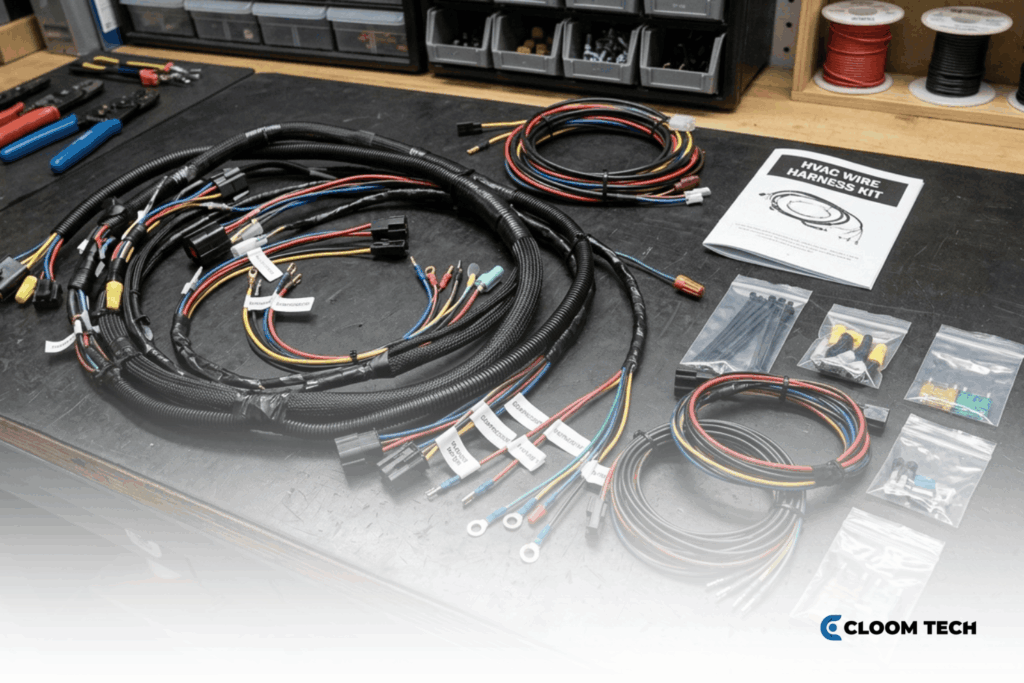
An HVAC wire harness kit has to connect every specified component while handling the conditions along each wiring route. Within the same unit, thermostat wiring carries low-voltage control signals while compressor circuits supply power under much heavier loads. Near hot components or condensation-prone surfaces, insulation and connector protection become part of the selection, too.
Buyers often find that a kit’s parts list alone doesn’t show whether it fits a furnace, air handler, or outdoor condensing unit. You’ll need to compare terminal types and pin assignments with your component interfaces, then check branch lengths against the installation layout. Generic kits suit configurations that match their documented specifications, while customized harnesses let you specify connections and routing for your equipment.
What is an HVAC Wire Harness?
An HVAC wire harness groups insulated conductors into one assembly that carries power or signals between heating, ventilation, and air conditioning components. Inside an air handler, it may link the control board with the blower motor and thermostat inputs. In a heat pump or condensing unit, harness branches connect compressor controls and defrost circuits through specified mating interfaces.
For original equipment manufacturers (OEMs), the word “kit” needs a defined purchasing scope, because suppliers package different assemblies together. One quote might cover a complete cabinet harness, while another covers only a motor branch with its mounting accessories. State the assembly boundaries and required quantities before you compare either offer with your bill of materials (BOM).
What’s Inside an HVAC Wire Harness Kit?
Every harness combines conductive parts with the insulation and mechanical protection required for its installation. When you review the BOM, identify each component by its approved part number or by a specification that permits a controlled equivalent. For a complete quote, list the supplied components and any accessories your assembly team will buy separately:
- Wire and conductors: Specify conductor material and size against the circuit load and operating temperature. Note stranding requirements where bends or equipment movement affect the wire choice.
- Terminals: Match quick-disconnect terminals to the mating tab dimensions, and size ring terminals for the specified stud. Confirm each terminal’s wire range before approving the wire-terminal combination.
- Connector housings: Record the mating part number and cavity assignments so the manufacturer can build the required interface. Where retention or moisture protection matters, identify the required locks and seals.
- Insulation: Specify the wire construction and electrical rating, with temperature suitability documented for the actual installed location. Keep conductor insulation requirements separate from any outer jacket or sleeve.
- Protection and identification: Include routing supports and abrasion protection where the harness crosses cabinet edges or runs near moving parts. Define wire labels and branch identification so assemblers can match connections to the approved drawing.
How HVAC Harness Kits are Classified
Manufacturers and buyers usually sort the types of wiring harness found in HVAC equipment by equipment application, circuit function, or temperature and material class. For purchasing, pair the equipment label with the circuit schedule and installation conditions, since one unit can contain branches from several classes.
| Classification Basis | Equipment or Circuit Example | Details to Specify |
|---|---|---|
| Equipment application | Furnace or air handler | Blower connection details, control-board interfaces and branch reach |
| Equipment application | Condensing unit or heat pump | Compressor-control interfaces, defrost connections, and outdoor exposure |
| Power function | Motor supply or heater branch | Operating current, starting conditions, and terminal ratings |
| Control function | Thermostat wiring or relay control | Circuit assignments, control voltage, and mating interfaces |
| Sensor or communication function | Thermistor connection or digital communication link | Signal requirements, interference exposure, and shielding |
| Temperature and material class | Hot-component branch or condensation-prone route | Wire temperature rating, moisture exposure, and mechanical protection |
In practice, a single furnace or heat pump harness often spans several classes. A defrost branch near the outdoor coil, for example, needs both a control-function specification and a moisture-rated construction.
Materials and Temperature Ratings
Select insulation against the temperature along the wiring route, including heat from nearby components and from the conductor’s own electrical load. Appliance wiring material (AWM) ratings depend on construction and intended use, so a polymer name alone doesn’t prove suitability.
Silicone, for example, handles heat well but resists abrasion poorly, so it may need extra protection where it crosses metal edges. Where your specification calls for UL-recognized wire, verify the supplier’s recognition record and the permitted conditions of use.
For high-temperature wire harnesses, specify the required thermal capability before selecting a wire construction or approving its termination components. You should also request material declarations covering RoHS compliance (Restriction of Hazardous Substances).
| Insulation | UL AWM Style Reference | Temperature Rating | Selection Check |
|---|---|---|---|
| Polyvinyl chloride (PVC) | AWM Style 1015 | 80°C, 90°C, or 105°C | Confirm which rating applies to the supplied construction |
| Cross-linked polyethylene (XLPE) | AWM Style 3173 | 125°C | Verify voltage suitability and required environmental resistance |
| Silicone rubber | AWM Style 30109 | 200°C | Check limits on movement and mechanical exposure |
| Polytetrafluoroethylene (PTFE) | AWM Style 1180 | 200°C | Confirm electrical ratings and termination compatibility |
Off-the-Shelf Kits vs. Customized HVAC Wiring Harnesses
An off-the-shelf kit can suit an OEM build when its documented configuration matches your approved assembly requirements without modification. Before choosing that route, check whether the supplier’s part numbers match your mating components and whether every branch reaches its assigned connection. Then include any adaptation work in the comparison, rather than comparing kit prices alone.
When available kits lack the required branch lengths or mating interfaces, compare a customized HVAC wiring harness with the cost of adapting a generic kit. A common challenge is that small adaptations, repeated across a production run, quietly add up to significant labor. Before comparing quotes, check these three points:
- Assembly fit: Compare the installation steps each option requires, including terminal changes or extra wire management. Add those operations to your labor estimate before deciding which quote offers better value.
- Production control: Specify the drawing revision and approved component substitutions so repeat orders follow the same documented configuration. For a new assembly, include sample approval before releasing production quantities.
- Purchasing scope: Confirm whether pricing includes labeling and the inspection records your quality team needs. Keep acceptance requirements consistent across suppliers so that the quotes cover comparable work.
Specify Your Customized HVAC Harness
At Cloom Tech, we manufacture customized HVAC harnesses with the terminal interfaces and branch lengths your equipment requires. Our DFM feedback works from your existing drawings, covering material selection, cost reduction, and production efficiency.
We’re ISO 9001 and IATF 16949 certified and built to IPC/WHMA-A-620 workmanship criteria. We deliver samples in 3–4 weeks and mass production in 4–5 weeks. We build every harness to your specification rather than pulling it from stock. Send us your drawings and operating requirements to request a quote for HVAC wire harness manufacturing.
HVAC Wire Harness Kits FAQs
How long does an HVAC wire harness last in outdoor units?
There’s no universal lifespan figure. Service life depends on temperature, moisture, UV exposure, and vibration at the installed location. Ask suppliers for qualification test evidence, such as temperature-life and humidity testing, which reflects your equipment’s actual operating conditions.
What happens if an HVAC wiring harness fails in the field?
It depends on the circuit. A failed power connection can stop the equipment, while an intermittent sensor connection can feed the controller unreliable readings. Connector corrosion and contact-retention failures commonly cause these open or intermittent faults. Specify production traceability and a corrective-action process so your quality team can investigate returns against manufacturing records.
Is tinned wire necessary in HVAC harnesses?
Not always. Tinned copper resists corrosion better than bare copper, so it’s worth specifying on moisture-prone routes and outdoor units. Evaluate the conductor finish alongside connector sealing and termination compatibility, and ask the supplier to document the basis for the proposed construction.
What electrical tests should an HVAC harness pass before shipment?
At a minimum, every harness should pass continuity and short-circuit checks. Insulation-resistance and high-potential (hipot) testing apply where your acceptance specification requires them. Crimp pull testing is a destructive process check, so request those records separately from the 100% electrical acceptance testing.
What causes terminals to loosen in compressor and outdoor circuits?
Vibration is a common cause. Repeated contact movement produces fretting corrosion and electrical intermittency at mating surfaces. Review the connector’s vibration qualification, support branches so they don’t pull on terminations, and include terminal-retention requirements in the acceptance package.
What sealing level do HVAC harnesses need against moisture?
Match sealing to the water exposure at each connector. For IP67 or IP68 ratings, confirm the tested configuration and whether protection requires a mated, locked connector. Water-exposure test methods separate immersion from spray exposure, so choose qualification conditions that represent your installation.
Back to Top: HVAC Wire Harness Kits: Composition, Classification, and Custom vs. Off-the-Shelf