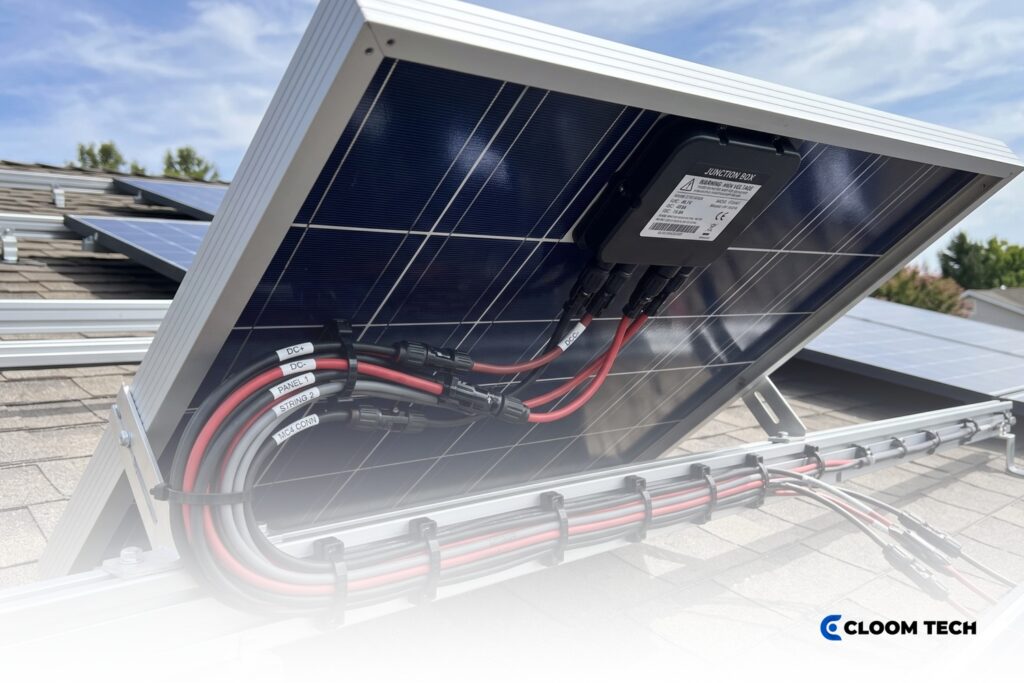
When you specify a solar cable assembly, UL 4703 establishes requirements for photovoltaic wire used in grounded and ungrounded solar power systems. Wire carrying a UL 4703 listing addresses one layer of your sourcing decision, and you’ll also need to account for every connection created during manufacturing.
Connector compatibility and sealing determine how the completed assembly manages moisture at its outdoor interfaces during service. Termination processing and material choices also influence how your assembly responds to sunlight exposure and repeated temperature changes.
Your complete drawing package should define both the listed wire and every applicable finished-assembly requirement before production begins. A practical sourcing review connects UL 4703 with insulation and weatherproofing requirements before translating them into supplier selection criteria.
What is UL 4703?
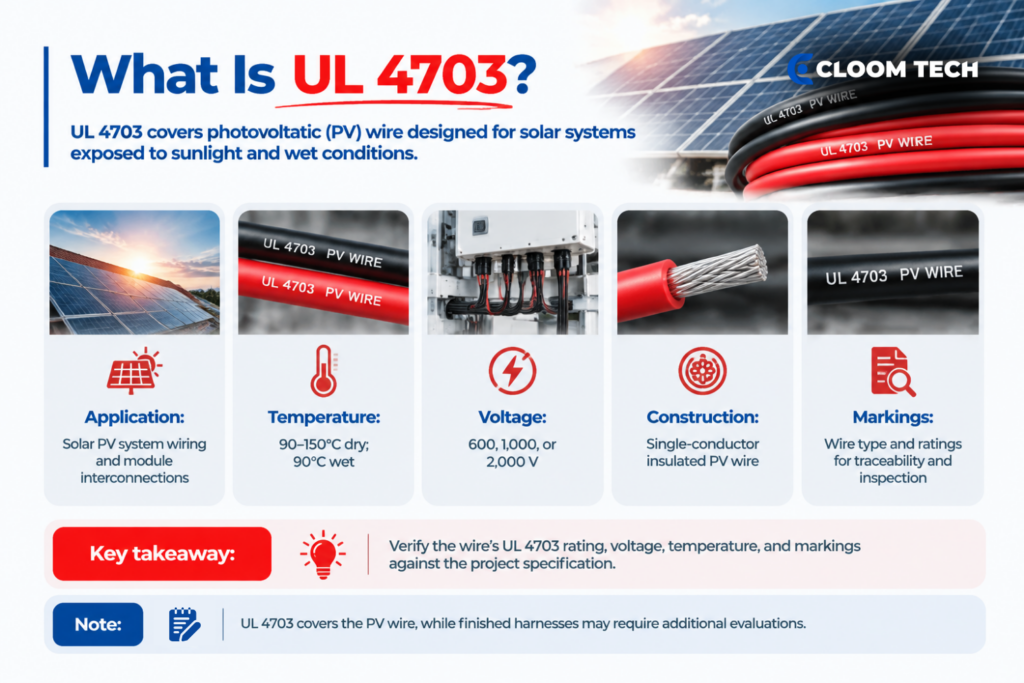
UL 4703 is an Underwriters Laboratories standard covering photovoltaic wire for system interconnections exposed to sunlight and wet conditions. You can use its marked ratings to confirm whether the selected wire matches your documented cable selection requirements.
Scope and rated conditions
The current UL 4703 product scope covers single-conductor, insulated photovoltaic wire with integral or separate jackets. Covered products carry a sunlight-resistant rating with dry ratings from 90 through 150°C under specified test conditions. Covered wire also carries a 90°C wet rating at specified voltage levels of 600, 1,000, or 2,000 volts.
UL 4703 supports wiring between modules and interconnections in the solar PV system described by National Electrical Code Article 690. The scope includes ungrounded PV configurations when approved equipment operates at higher system voltages within qualifying installations. Your drawing must identify the exact voltage rating because product certifications carry specific subsets of covered ratings.
Product markings and certification relevance
The printed legend identifies the photovoltaic wire type and applicable ratings; check these against your certification record during incoming inspection. Match each accepted item to its certification record and your order specification before production cutting begins.
Your compliance review should distinguish the standard for a photovoltaic wire from any finished-harness evaluation required by your solar wire harness manufacturing specification.
UL 9703 separately covers certain distributed-generation wiring harnesses that interconnect modules or system equipment within distributed generation installations. Your compliance plan should identify the standard for PV wire and any evaluation required for the finished solar photovoltaic product.
UL 4703 vs. Standard PVC Insulation
UL 4703 defines evaluated sunlight and wet-temperature performance, whereas a generic PVC description identifies only the insulation chemistry. For your comparison, the marked product ratings determine exposure capability—not the polymer name alone.
Exposure and temperature performance
Verify the sunlight-resistant marking and wet rating against your operating conditions before approving photovoltaic wire. A USE-2 cable follows another product standard and requires separate confirmation of its ratings for the proposed route. Selecting the correct cable requires verification of each wire type against the expected installation environment.
Material durability during outdoor service
Outdoor durability depends on the complete insulation and jacket construction, including compound formulation and any specified outer layer. XLPE insulation can support heat and weather performance, although UL 4703 permits more than one polymer family.
Among the available types of solar cables, IEC 62930 addresses cross-linked insulated photovoltaic cable rated through 1.5 kilovolts DC. The IEC document permits continuous conductor operation at 90°C and limited operation at 120°C. Material construction influences electrical insulation performance, so you should approve a specific datasheet rather than a broad description.
Weatherproofing Requirements for Solar Cable Assemblies
Weatherproofing begins at the cable-to-connector interface wherever a finished harness may encounter water or sunlight. Your review should compare seal fit and termination processing with the specified exposure conditions for outdoor environments.
Connector and cable compatibility
Every connector contact must accept the specified conductor material, strand construction, and cable size within the manufacturer’s published range. UL 6703 applies to connectors for photovoltaic systems and evaluates mating parts from the same manufacturer unless a submitted combination demonstrates intermatability.
Connector selection for a PV cable assembly should match the cable diameter because compression seals operate within defined limits. The specified assembly drawing should identify both connector part numbers, preventing substitutions based on similar housing geometry.
Sealing and termination control
Seal performance depends on correct stripping dimensions and complete terminal insertion, followed by proper strain relief at each cable entry. Damaged strands can change resistance, and displaced seals can create a path for moisture ingress near energized contacts.
Repeated thermal cycling can move materials at connector interfaces because metals and polymers expand at different rates. Production controls should confirm crimp height and conductor position, followed by continuity testing under the approved test plan. Suitable seals support corrosion resistance in outdoor environments by limiting water access to stripped ends.
Harness routing for solar panel connections should protect cable surfaces from sharp edges and sustained mechanical loading during installation. Follow bend-radius limits and connector instructions carefully; field handling can compromise a factory-verified termination.
UV and Weather-Rating Table
UL 4703 photovoltaic wire receives 720 hours of weatherometer exposure and undergoes low-temperature flexibility testing at −40°C. Use the table below to compare its key performance parameters against generic PVC when reviewing your cable selection.
| Specification point | UL 4703 photovoltaic wire | Standard PVC description | Your verification |
|---|---|---|---|
| UV exposure | Receives 720 hours of weatherometer exposure. | Product-specific documentation must establish its UV exposure rating. | Verify the sunlight-resistant marking and certification record. |
| Cold bend | Undergoes low-temperature flexibility testing at −40°C. | Product-specific documentation must state its cold-bend temperature. | Match the marked product to your minimum site temperature. |
| Wet temperature | The covered 90°C wet rating applies. | Product-specific documentation must state its wet-temperature rating. | Match the wet rating to approved installation conditions. |
| Flame performance | Requires a specified vertical flammability test. VW-1 is available as an optional classification. | PVC chemistry alone does not establish a flame classification. | Specify FT1 or VW-1 when required, then confirm the exact marking on the selected wire. |
| Finished connection | Connector documents and finished-harness tests establish interface exposure performance. | Product-specific testing must establish finished-connection performance. | Verify connector compatibility and any finished-harness test requirements. |
What to Specify When Sourcing a Solar Cable Assembly Partner
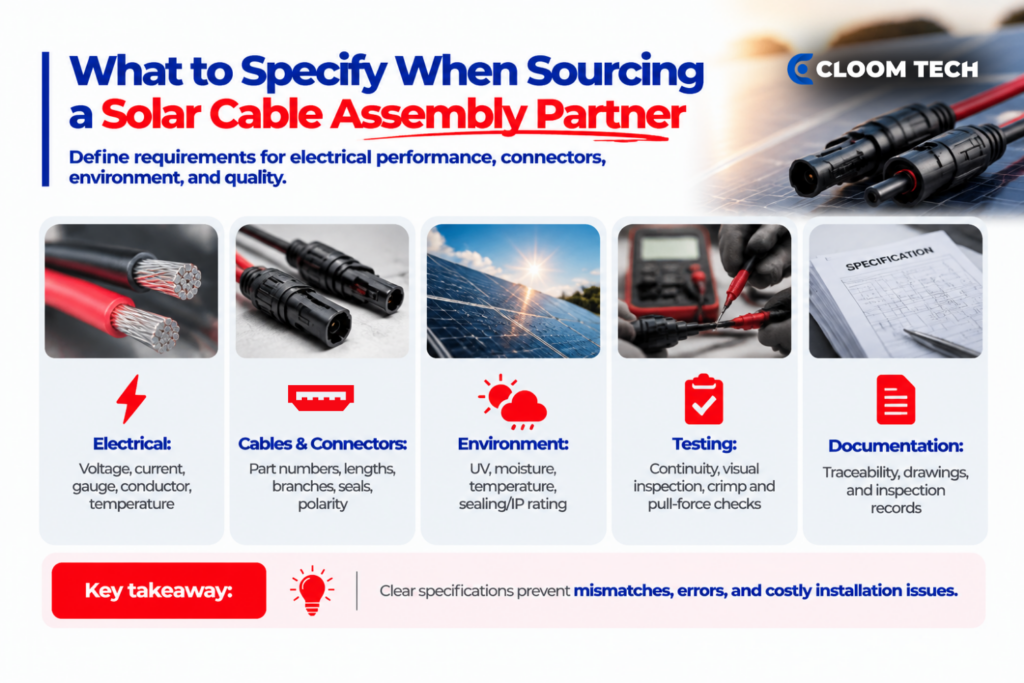
Your solar cable assembly sourcing package should convert system requirements into controlled material callouts and measurable acceptance criteria. Consistent project documentation supports accurate quotations and controlled interpretation during prototype reviews and production stages.
Application and electrical requirements
Define operating voltage and circuit current before approving conductor gauge because both values influence insulation rating and ampacity. An 8 AWG wire callout remains incomplete without conductor material and defined operating temperature assumptions.
Specify tinned copper or another approved conductor, including permitted aluminum alloy construction where applicable. Your solar application should distinguish residential and commercial equipment from utility-scale projects, particularly when high-voltage circuits require different connector specifications.
Cable and connector details
Identify the approved cable part number together with the connector family and mating component for every termination. Contacts should match conductor stranding, and seal ranges should match the specified finished cable diameter.
For a solar wire harness used in PV arrays, your bill of materials should specify branch quantities and finished lengths. Labeling content and polarity conventions can prevent installation errors at solar farms or smaller equipment locations.
Environmental and sealing requirements
State the expected temperature range and UV exposure level, then define potential contact with rain or temporary immersion. Utility-scale solar equipment may require different protection because routing and maintenance access create separate exposure conditions.
Your specification should address the intended service life through measurable weatherproofing ratings, without treating laboratory exposure as guaranteed field duration. A high-performance sealing request needs an ingress rating or test method that creates an acceptance threshold.
Testing and documentation
Require continuity testing and visual inspection against the approved drawing, plus any specified crimp-height or pull-force checks. A documented wire harness manufacturing process connects incoming material verification with final inspection records for traceability.
Your quality package should define records needed to demonstrate safety and performance for the intended use. Volume forecasts may influence tooling decisions, but approved controls should remain consistent between lots. Early documentation reduces installation costs by preventing connector mismatches and incorrect branch lengths before equipment reaches the site.
Source a Solar Cable Assembly Built to Your Specifications
Cloom Tech manufactures custom cable assemblies and wire harnesses from customer-supplied drawings that define each project’s application and performance requirements. Our team can review your existing documentation for manufacturability and recommend suitable materials after identifying production issues, without providing ground-up engineering services.
Your request should identify the UL 4703-rated cable type, connector part numbers, and seal specifications for each branch or termination. The drawing package should state the UV exposure, temperature range, and weatherproofing requirements, together with applicable tolerances and test criteria. We can then align material sourcing and assembly processing with the approved specification throughout each production stage.
Request a custom assembly quote to discuss your solar application and upload your drawings.
Solar Cable Assembly Manufacturing FAQs
Can UL 4703 photovoltaic wire be installed underground?
The exact product marking and applicable installation rules determine whether you may route UL 4703 wire underground. Confirm the cable certification, then align routing with National Electrical Code Article 690 and local requirements. Your approved installer should confirm whether the marking authorizes direct burial or requires raceway protection.
How should conductor stranding affect terminal selection?
Conductor stranding affects barrel compression and wire retention, so each approved contact needs a compatible conductor range. Specify documented strand construction and terminal part number, followed by approved applicator and inspection requirements. Substituting finely stranded wire into a terminal qualified for another construction can change crimp geometry and pull-force results.
Which documents should define installation requirements?
Your approved drawing and bill of materials should control manufactured dimensions and component identities for the completed harness. Cable datasheets and connector instructions define product limits, with the applicable national electrical code and local rules governing installation. Resolve conflicts before production because the authority having jurisdiction sets the installation requirements governing the released drawing.
Does UL 4703 certification on the wire guarantee that the finished cable assembly is weatherproof?
UL 4703 certifies the photovoltaic wire itself – its UV resistance, wet temperature rating, and flame performance – not the completed assembly. Weatherproofing of the finished cable assembly depends on connector sealing, termination quality, and the installer’s compliance with bend-radius and strain-relief requirements. Specify connector ingress protection ratings and assembly workmanship criteria separately to cover the full outdoor exposure path.
Back to Top: Solar Cable Assembly Manufacturing: UL 4703 & Weatherproofing Standards