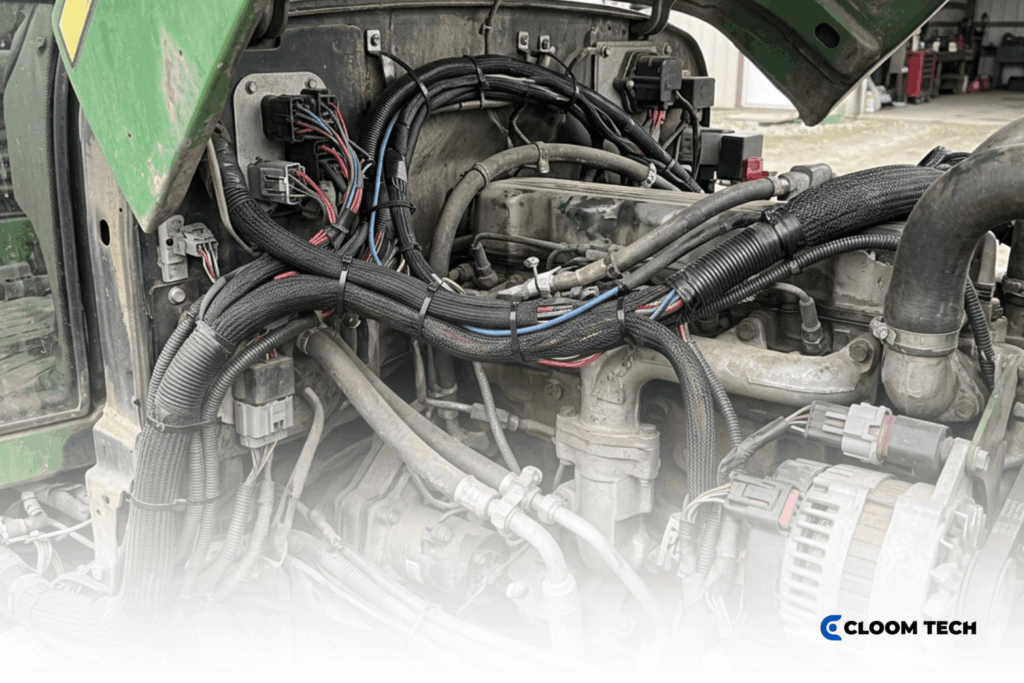
A tractor wire harness can pass continuity testing at the factory and still fail in the field. Vibration loosens a terminal, or washdown water reaches a connection. During planting or harvest, either fault can stop a machine at exactly the point when there’s no room in the schedule for downtime.
That’s why an agricultural wire harness needs a specification built around real field conditions. Define the vibration exposure and cleaning conditions at each connection, along with the temperatures and fluids along every route. Your operating profile should also cover electrical loading during peak seasons and storage conditions during the off-season.
What Makes a Tractor Wire Harness Different
Tractor harnesses connect sheltered cab controls to exposed implements, with branches crossing engine heat and moving attachment points in the same electrical system. Compared with indoor equipment, agricultural machinery also exposes wiring to field chemicals, mud, UV, and months of outdoor storage between intensive seasons.
ISO 15003 environmental requirements define tests and severity levels for electrical equipment on mobile agricultural machinery, including tractors and implements. These severity levels offer general guidance rather than absolute worst-case limits, so identify the applicable tests and acceptance criteria for your own installation.
For tractor wire harness manufacturing, your quote request (RFQ) needs a controlled drawing revision and a connection schedule that identifies each circuit. Record branch dimensions from defined reference points and position connectors relative to mounting hardware. This ensures that sample inspection can confirm the assembly fits.
Vibration and Shock
Vibration and shock qualification should include electrical checks before and after exposure, with continuity monitoring during the test where practical. Where engine heat accompanies vibration, consider combined environmental testing so qualification reflects simultaneous exposure rather than separate laboratory conditions.
Vibration damage tends to concentrate where heavy branches hang unsupported from a connector or where an implement link moves through its full travel. Your specification should address these points directly:
- Vibration testing: Specify the frequency range, acceleration profile, and test duration, and document a mounting arrangement that represents the real installation.
- Shock testing: Define acceleration and pulse duration separately, including the impact directions and number of shocks your equipment specification requires.
- Implement movement: Establish the full articulation range and branch length, with enough clearance to keep wiring away from moving hardware throughout travel.
- Routing and securing: Mark clamp locations and permitted bend radii on the drawing, and position supports to keep branch weight off connector exits.
- Termination checks: Specify crimp pull-force acceptance separately from contact seating and secondary-lock inspection, because conductor attachment and connector retention are different assembly features.
Ingress Protection (IP) Ratings
Ingress protection ratings classify protection against dust and water under defined test conditions, so the rating you specify must match each connection’s actual exposure.
A cab-mounted connector and a connector on a sprayer boom face very different water conditions, even on the same machine. Select IP ratings based on that exposure, and name the governing standard and edition in your RFQ. For sealed connectors such as Deutsch DT, assembly details decide whether production matches the qualified configuration:
- Wire seals: Match the specified wire outside diameter to the connector’s seal range, and inspect seals for damage during assembly.
- Unused cavities: Fit the specified cavity plugs, and document whether qualification applies with the connector mated or fitted with a protective cap.
- Overmolded transitions: Define the encapsulation area and molding material, check compatibility with the cable jacket, then qualify the completed junction at the wire-entry point.
Under ISO 20653 protection classifications, IPX9K identifies water protection but leaves the solid-particle rating unspecified. For dust-exposed connections, request the full rating code, such as IP6K9K. Where immersion and pressure cleaning both occur, ask for qualification evidence for each exposure, since one water test doesn’t prove the other.
| Rating | Water Exposure Covered | Specification Implication |
|---|---|---|
| IP67 | Temporary immersion under defined test conditions, plus dust-tight protection | Identify the required immersion conditions and the assembled connector configuration. |
| IP68 | Continuous immersion under conditions agreed between manufacturer and user | Record the agreed depth and duration, since IP68 has no single fixed test condition. |
| IP69K / IP6K9K | High-pressure, high-temperature water jets, as used in washdown cleaning | Name the governing standard and washdown conditions, then request test results for the exact connector or molded assembly. |
Duty Cycle and Seasonal Use
Duty cycle describes electrical loading over time, including energized periods and the intervals between them across the machine’s operating schedule. A continuously powered work-light circuit, for example, needs a different load profile from an implement valve energized intermittently during a planting shift.
This matters most during harvest, when machines often run long shifts and circuits that sit idle for months suddenly carry sustained loads. Build these points into your specification:
- Peak operation: Record daily operating hours, continuous load duration, and current requirements for each circuit during the busiest part of the season.
- Temperature limits: Establish operating and storage temperature ranges for each installation zone, including areas near engine heat and outdoor winter storage.
- Thermal cycling: Specify heating and cooling rates and cycle count, then define the electrical checks and physical inspection required after exposure.
- Idle storage: Identify outdoor or covered storage and condensation exposure, and specify protective caps for implement connections left disconnected between seasons.
- Pre-installation handling: Define packaging and storage requirements for completed harnesses held through a production gap, including protection for exposed contacts and seals.
Chemical, UV, and Abrasion Resistance
Chemical, ultraviolet (UV), and abrasion resistance need separate specifications because fluid compatibility doesn’t prove weathering performance or protection against repeated rubbing.
Assess exposed insulation, outer coverings, and connector seals, and include identification labels where outdoor exposure could affect legibility. Buyers often find that a material rated for diesel says little about concentrated fertilizer. The same goes for years of sun on an open implement.
- Fertilizer contact: Identify the formulation, dilution, and contact temperature, then specify splash or sustained exposure and inspection limits for swelling or cracking.
- Hydraulic fluid and diesel: Record the exact fluids and exposure durations separately, with acceptance criteria for insulation damage and loss of sealing performance.
- UV exposure: Request weathering evidence for the specified materials, with post-exposure requirements for physical condition and label readability.
- Abrasion exposure: Specify convoluted tubing or wire loom along vulnerable branches, grommets at frame penetrations, and clearance from surrounding metalwork.
While GXL and TXL both use cross-linked automotive wire insulation, their wall thicknesses differ—GXL is thicker, TXL is thinner—which affects the finished bundle size and routing space. Verify the specified product’s temperature rating and check available routing space before approving either one.
SAE J1128 primary-wire qualification covers cable for normal vehicle applications with limited fluid exposure and physical abuse. Agricultural conditions outside that scope need additional evidence for the named chemicals or mechanical exposure, rather than relying on automotive wire classification alone.
Agricultural Wire Harness Specs by Application
Agricultural wire harness specifications must cover every exposure zone a branch crosses, even when its endpoint belongs to a different application. A lighting feed routed through the engine bay, for example, needs insulation suited to that route’s temperatures, plus weather sealing at the lamp.
| Application | Electrical Duty Cycle | Temperature and Vibration Specifications | Water and Chemical Exposure |
|---|---|---|---|
| Cab | Control-circuit current during operation and standby, with energized periods | Operating and storage temperature limits, with vibration requirements at panel-mounted connections | Condensation at cab entry points, plus cleaning-fluid exposure where applicable |
| Engine bay | Continuous circuit loads and intermittent starting loads, with their duration | Local temperature limits and post-shutdown heat soak, with engine-mounted vibration and shock profiles | Sealing at exposed connections, with identified hydraulic fluid and diesel contact |
| Implement | Valve or actuator current and energization frequency, with operating duration | Outdoor temperature limits, with vibration and shock requirements at implement mounting points | Specified immersion or pressure-cleaning exposure, plus fertilizer formulation and concentration |
| Lighting | Lamp current and continuous operating duration, including simultaneous lamp combinations | Temperature limits at lamp connections, with vibration at mounting brackets | Weather and washdown exposure, plus chemical contact identified for the installation location |
How We Manufacture Agricultural Wiring Harnesses
At Cloom Tech, we manufacture agricultural wiring harnesses with sealed connectors and protective coverings matched to your specified field conditions. For engine-bay branches or exposed implement connections, our DFM feedback reviews your existing drawings and recommends suitable materials. We document acceptance limits for component inspection and completed-assembly testing:
- Production preparation: We translate your connection schedule into assembly instructions and test requirements, with the approved revision controlling every document on the production floor.
- Incoming inspection: We check supplied components against the manufacturing documentation before assembly, including approved part identities and any authorized substitutions.
- Assembly inspection: We check crimp quality and contact insertion against IPC/WHMA-A-620 acceptance limits, and dimensional inspection confirms branch lengths and breakout positions.
- Electrical verification: We test completed assemblies against the approved connection requirements, with test documentation agreed upon when you define the inspection plan.
Request a quote for your agricultural harness, and send your drawings and environmental requirements so we can tailor the manufacturing scope to your agricultural application requirements.
Agricultural & Tractor Wire Harness Manufacturing FAQs
What IP rating does a tractor wire harness need?
It depends on the connection’s location. Cab connections often need little more than condensation protection, while exposed implement and engine-bay connections commonly call for IP67 sealing. Where machines go through pressure washing, specify IP6K9K and request test evidence for that exact connector configuration.
Does every implement harness need ISOBUS?
No, only implement harnesses intended for the agricultural communication system defined by ISO 11783 need ISOBUS specifications for their network connections. Compatibility depends on shared ISOBUS system functionalities, so a matching connector alone doesn’t confirm interoperability. For controller area network (CAN) bus wiring, specify cable construction and the termination arrangement your machine’s network requires.
What should you specify for agricultural lighting circuits?
Lighting circuit specifications need operating voltage, lamp current, and the permitted voltage drop across the full supply and return path. Include connector current limits and circuit protection in the connection schedule, then validate performance with the specified lamps under their intended operating load.
What evidence should accompany sample approval?
Sample approval requires a signed acceptance record identifying the sample lot and approver, with an explicit disposition for every deviation. For any open actions, record the responsible person and completion date before authorizing production. Your purchase specification should also state who from each party is authorized to approve changes after the purchase order is issued.
Back to Top: Agricultural & Tractor Wire Harness Manufacturing: Vibration, IP, and Duty-Cycle Specs