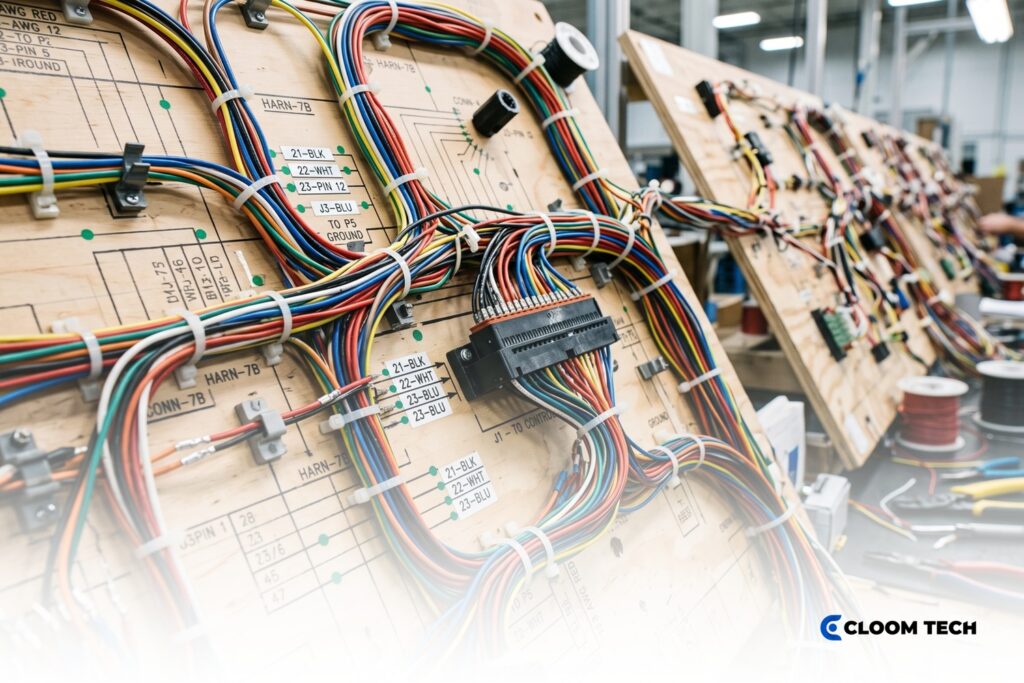
A wire harness board is a physical production fixture that guides technicians as they position each harness component during assembly. Also called a formboard, it maps the harness geometry on a flat surface using marked routes plus fixed reference points. Each reference can show where a component belongs within the finished assembly.
Technicians use the board to reproduce the routing and component positions specified in the production documentation. This controlled assembly board layout supports consistent routing during repeat builds, particularly when the harness has complex branch geometry.
Engineers can examine the method to evaluate routing control. Procurement professionals can use the same evidence when matching a production method to anticipated order volume.
What is a wire harness assembly board (formboard)?
A wire harness board provides a full-scale physical reference for the routes and component positions specified in your approved production documentation. Technicians use its marked layout and fixtures to position the harness during assembly.
If your documents use “harness assy,” the abbreviation refers to the harness assembly rather than the board used to build it. Keeping that distinction clear helps you separate product requirements from the manufacturing fixture.
Which physical features appear on a formboard?
Marked positions can identify controlled dimensions, branch locations, or component orientations specified for the assembly. The selected fixtures depend on the harness configuration and the physical controls required during production.
Common formboard features include:
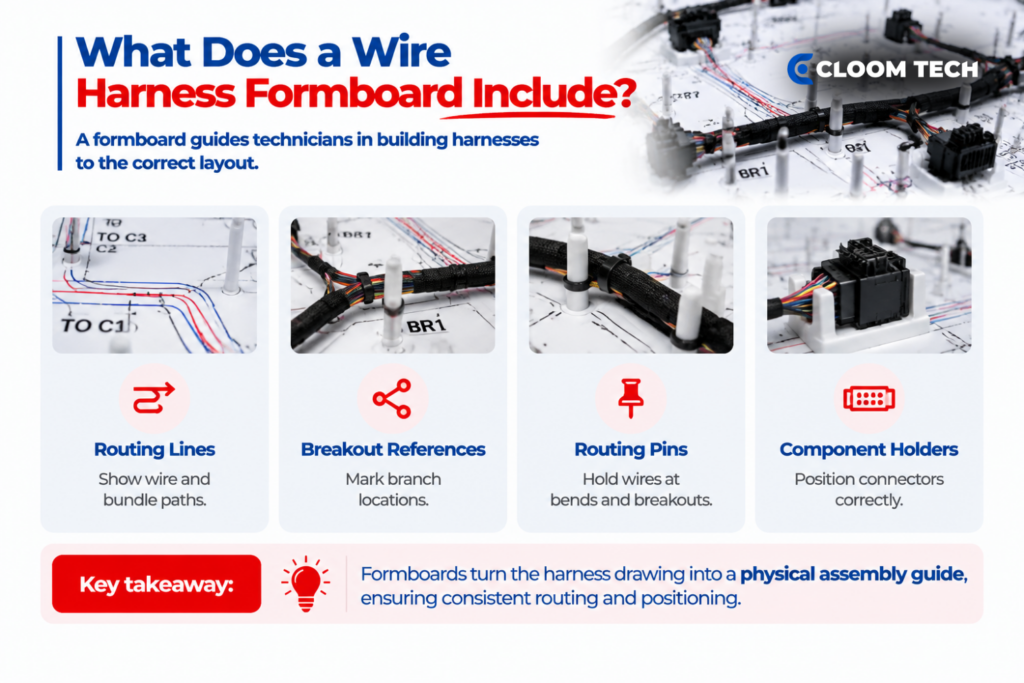
- Routing lines: Full-scale markings show the path that individual conductors or formed bundles should follow during physical assembly.
- Breakout references: Printed positions identify where selected conductors separate from the main bundle to create the required harness branches.
- Routing pins: Pins, pegs, or bundle forks sit at specified bends and breakouts, turning a printed route into a physical path.
- Component holders: Where required, dedicated holders maintain specified connector positions or orientations during the surrounding assembly work.
Printed lines show the route, and the fixtures make that route physical for technicians. A misplaced pin can reproduce the same routing error during repeat builds unless inspection identifies the problem.
Cloom Tech uses pegs and fixtures on full-scale boards to guide conductors along specified paths.
When does a manufacturer use a formboard?
A manufacturer may use a formboard when harness complexity, physical tolerances, or recurring production justify a stable full-scale reference. Fixed breakout positions and connector orientations can make fixturing useful even for an initial low-volume order.
A bench build may suit a straightforward sample when controlled measurements provide enough information to verify its physical configuration. The manufacturer should consider harness length, inspection requirements, and anticipated production quantity before selecting the assembly method.
Ask why the manufacturer selected its production method for your harness. The answer should connect the proposed fixture to the required geometry, inspection needs, and production quantity.
How pin-and-route layout works
Pin-and-route layout converts the dimensions in an approved drawing into physical reference points on the assembly board. Technicians route each conductor between those points before securing the wires into the required bundle.
How is the pin-and-route layout prepared?
Production personnel typically prepare the layout from the current customer drawing, which identifies dimensions and applicable component locations. The resulting board should represent the approved harness configuration without changing its underlying requirements.
The preparation process can establish:
- Board scale: A full-scale layout gives technicians a direct physical reference for the specified harness dimensions.
- Fixture coordinates: Marked locations identify where routing pins or component holders should sit on the board.
- Breakout positions: Physical references show where selected conductors leave the main bundle and begin a separate branch.
- Revision linkage: Board identification can connect the fixture to the customer drawing released for the applicable production order.
When a formboard uses connector holders, those fixtures can establish the specified positions for the relevant wire ends. Routing pins can then define the path between holders without requiring technicians to recreate the route from separate measurements.
Different wire harness boards may use fixed fixtures or repositionable systems according to the manufacturing setup. Repositionable fixtures require verification after each setup change because their coordinates determine the physical route presented to technicians.
How do technicians use the layout?
Technicians use the pin-and-route layout as a physical guide during conductor placement and bundle formation. The approved work instruction determines the applicable routing sequence and securing method.
A typical production sequence can include:
- Position the fixtures: Production personnel set the required pins or holders according to the current approved layout.
- Place the components: The operator secures each applicable connector or wire end at its assigned board position.
- Route the conductors: Technicians lay each wire along the marked path and around the fixtures at specified direction changes.
- Secure the bundle: The routed conductors receive the tape, ties, or sleeving identified in the applicable work instruction.
Some physical checks may occur before technicians remove the harness from the board. Other manufacturers may transfer the assembly to a separate inspection station, depending on their process and the customer’s requirements.
For the manufacturing stages surrounding board-guided assembly, see how a wiring harness is assembled.
How does the board support physical inspection?
A populated harness board provides reference points that inspectors can use to evaluate the completed physical configuration. Applicable checks may cover branch length, breakout position, or connector orientation.
Branch endpoints can be compared with their printed locations to identify excess length or insufficient reach. Breakout references also help inspectors determine whether each branch begins at the position specified for the assembly.
Formboard inspection addresses physical configuration rather than electrical performance. An electrically correct harness may still have unsuitable branch geometry, and a correctly routed harness may still contain an electrical fault. Separate electrical testing verifies requirements that routing lines and physical fixtures can’t confirm.
Why does revision control matter?
Revision control reduces the risk of technicians using an obsolete board after the customer changes the harness requirements. A controlled production process should identify the board and link it to the current assembly revision.
If the customer releases revision B but the formboard still represents revision A, technicians may continue reproducing the earlier configuration. Manufacturers can manage that risk by updating the fixture or removing the obsolete board from active production.
Repositionable fixtures require the same review because changed pin coordinates alter the route presented to the operator. For traceable production, records can identify the approved layout used for each lot.
Formboard-based vs. hand-built assembly
Both formboard-guided and bench-based assemblies rely on manual production, but they provide different levels of physical routing control. A formboard supplies a reusable full-scale reference, whereas a bench build relies heavily on separate measurements.
How do the assembly methods compare?
The appropriate method depends on the harness geometry, required tolerances, and anticipated production quantity. Either approach can produce a conforming harness when the manufacturer applies suitable work instructions and inspection controls.
| Comparison area | Formboard-guided manual assembly | Freehand or bench-based manual assembly |
|---|---|---|
| Consistency | Fixed reference points help technicians reproduce specified routes and breakout positions during successive builds. | Technicians recreate the required dimensions from drawings, templates, or separate measurements during each build. |
| Repeatability | A verified board presents the same physical reference until an approved change requires an update. | Repeatability depends more heavily on the measurement controls applied to each assembly. |
| Typical volume fit | Repeated production or complex geometry may justify preparing and maintaining a dedicated formboard. | Samples or straightforward low-volume assemblies may suit bench production when separate controls provide sufficient accuracy. |
Read the table as a production-fit guide rather than a quality ranking. A well-controlled bench build can produce more accurate physical geometry than an outdated or poorly controlled board.
Formboard-guided production may suit a low-volume harness with several breakouts because its geometry requires a stable physical reference. Bench assembly may suit a high-volume harness when its simple configuration remains easy to measure and inspect.
Does either method guarantee better quality?
Neither assembly method guarantees higher quality because the selected fixture represents only one production control. Formboard use alone doesn’t confirm material identity, workmanship, or electrical performance.
You should evaluate whether the manufacturer’s chosen method matches your harness requirements and production plan. A specific explanation based on geometry and inspection needs provides more value than a general preference for one assembly method.
Separate electrical testing remains necessary when your acceptance requirements include continuity or other electrical characteristics.
What this signals about a manufacturer’s process
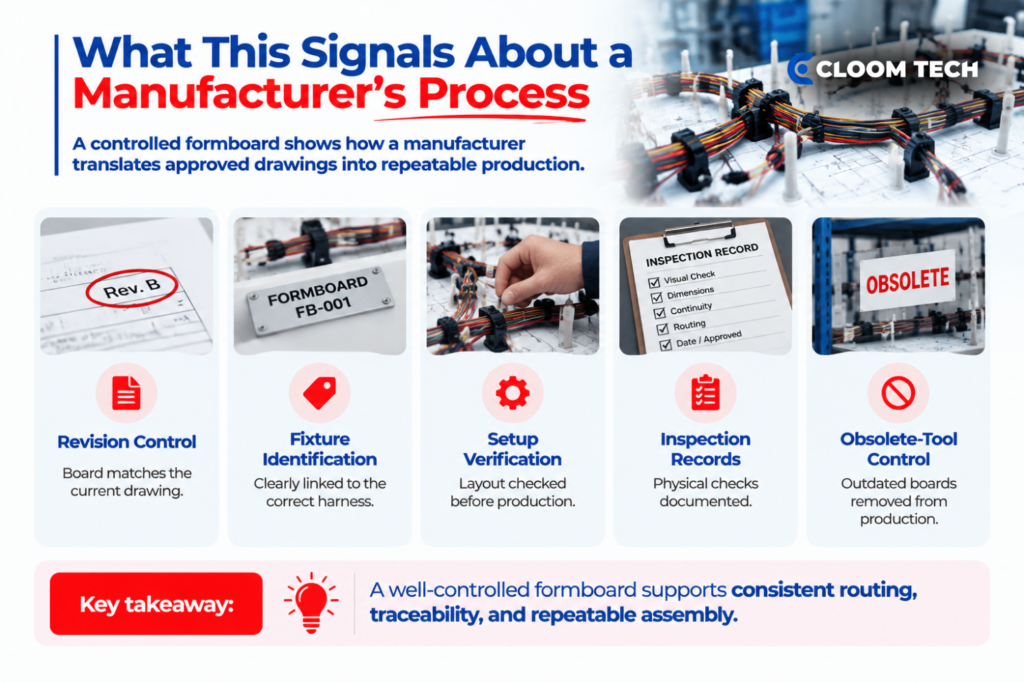
Formboard use can indicate that a manufacturer translates approved customer information into controlled shop-floor references. The board provides meaningful evidence when documented tooling controls and inspection records support its use.
Does the formboard match the approved revision?
A controlled formboard should display enough identification to connect it with the applicable assembly revision. Matching information helps you determine whether the fixture corresponds with the documents released for your order.
The fixture should also remain distinguishable from boards used for similar harnesses. Visual similarity between two assemblies doesn’t make their branch locations or overall dimensions interchangeable.
You can ask:
- What identifies each board? The fixture should connect clearly with a specific assembly and its currently released production documentation.
- Which step confirms revision status? Production personnel should verify the approved board before beginning the applicable manufacturing run.
- When do approved changes reach production? A controlled process should update affected fixtures and work instructions before revised production begins.
- How are obsolete boards controlled? You can ask how the manufacturer removes outdated fixtures from active production.
Which controls should support production fixturing?
Production fixturing should operate with documented revision control and recorded inspection appropriate to the assembly. Board identification can link the fixture to the current drawing, and inspection records can document the completed physical checks.
Relevant buyer evidence can include:
- Fixture identification: The board reference connects the production tool with the assembly and drawing revision authorized for use.
- Setup verification: Recorded checks confirm that repositionable fixtures match the approved layout before production begins.
- Inspection records: Completed records identify the physical characteristics evaluated for the applicable production lot.
- Obsolete-tool control: The manufacturer explains how outdated boards remain separated from fixtures released for active production.
Electrical test results can confirm specified requirements that the physical board cannot verify.
Move your wire harness into production with Cloom Tech
Cloom Tech manufactures customized wire harnesses and cable assemblies from customer-supplied specifications. Our production teams use formboard-guided assembly to reproduce approved routing, branch geometry, and component positions consistently across prototype and production quantities.
We review your existing drawings and can provide Design for Manufacturability (DFM) feedback to support cost reduction, material selection, and production efficiency. Sample builds typically take 3–4 weeks, and mass production typically takes 4–5 weeks.
Need a wire harness or cable assembly for your next project? Get a free quote to discuss your specifications with our team.
FAQs on What Is a Wire Harness Assembly Board
What information should you provide before a manufacturer prepares a formboard?
Provide the current drawing revision, specified dimensions, and applicable component orientations for the proposed build. The manufacturer may also need your bill of materials and production requirements before preparing a wire harness board layout.
Can a manufacturer reuse a formboard after the harness drawing changes?
A manufacturer can reuse a formboard after confirming that its fixtures still match the newly approved requirements. Affected pins or holders should be repositioned before the manufacturer releases the harness board for revised production.
How should a manufacturer verify adjustable wire harness boards?
A manufacturer should compare repositionable fixtures with the approved layout before using the board for production. Setup verification can confirm that adjustable wire harness boards retain the required route after fixture changes.
What happens to the formboard after a production order ends?
A manufacturer may store a formboard for recurring work when the tooling agreement and revision status support reuse. The applicable agreement should define storage, maintenance, and future production access.
Who owns the formboard used for production?
Formboard ownership depends on the commercial agreement between you and the manufacturer. Your quotation or tooling agreement should identify ownership, storage responsibilities, and any conditions governing future use.
Back to Top: What is a Wire Harness Assembly Board? Formboards and Production Fixturing Explained