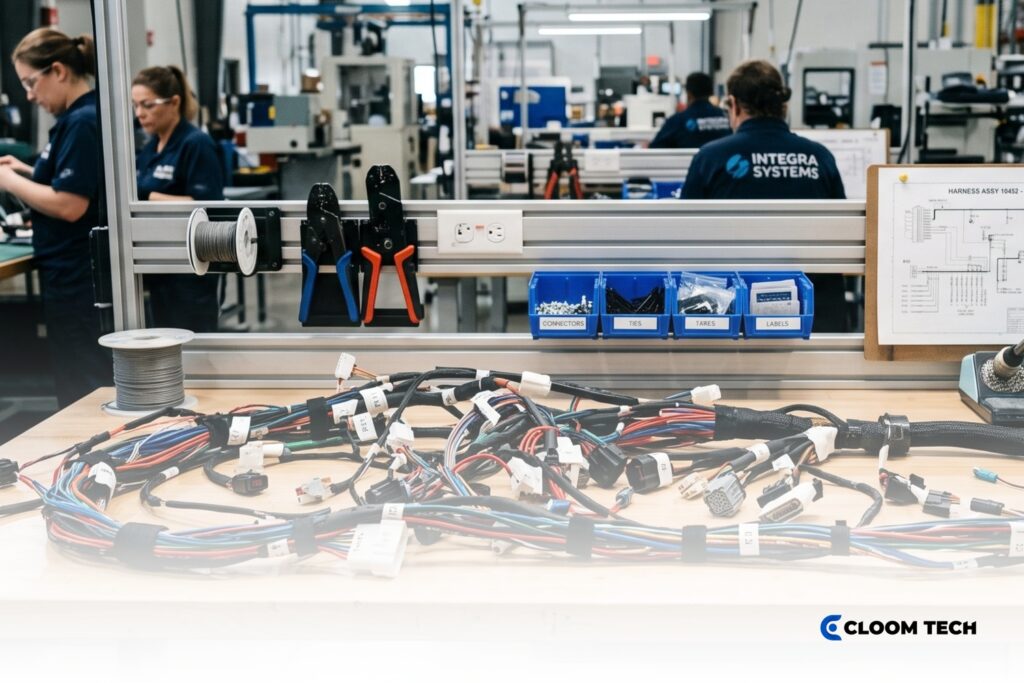
Specifying the right wiring harness connector and terminal combination starts with the specific assembly requirements. Procurement professionals and engineers need to assess the application and operating environment before defining the mating interface and wiring needs. Connector series vary by contact count and current range, with retention features and environmental seals differing by series.
The compatible terminal must match wire gauge, insulation diameter, and required electrical performance. Within a customized wire harness or cable assembly, you should specify the connector and terminal as a matched system. Deutsch, TE Connectivity, Molex, and JST provide different options for terminal pairing and mating requirements.
How to Think About Connector Selection
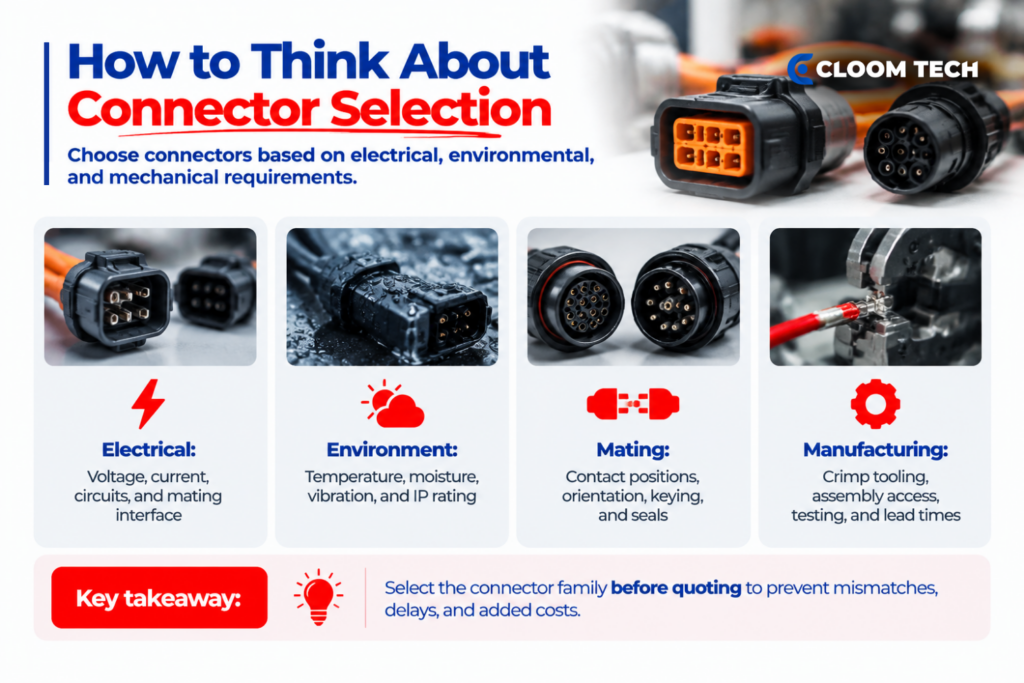
Connector-family choice shapes the complete assembly because effective selection criteria must connect each specified electrical connection with its operating conditions.
Start with the application requirements
Begin by defining what the connector must carry and where it must connect. Selecting a connector for power requires different priorities than choosing one for sensor signals. Connection style determines whether the assembly needs a header and receptacle or a wire-to-wire interface.
To make these requirements clear, record the following application details in the request for quotation (RFQ):
- Electrical load: State the voltage and the current a terminal can safely carry under the expected operating conditions.
- Circuit arrangement: Identify every signal or power circuit and its assigned cavity.
- Mating interface: Provide the mating component’s manufacturer and part number.
- Service expectations: Document the anticipated mating cycles and maintenance access.
Account for the operating environment
Temperature and mechanical movement influence the housing system, including whether an automotive wiring harness needs a sealed series for moisture exposure. Sealed connectors can protect exposed automotive wiring interfaces on outdoor industrial equipment, and unsealed families may suit enclosed board interfaces.
Environmental requirements should define the expected temperature range and exposure conditions, including the required ingress protection rating when sealing matters. Specifications should also state shock and vibration resistance requirements, which help distinguish suitable series among available wiring harness connector types.
Define contact positions and mating requirements
Contact positions must accommodate the cavity map without creating unnecessary size or cost. The drawing should identify orientation and keying, along with any connector or terminal position assurance feature.
The chosen housing and contact form a complete connector system, with matching seals added when required. Although drawings may label mating components as wiring harness plugs and receptacles, specifying each cavity’s contact or plug prevents mismatches during harness production.
Review manufacturability using existing drawings
Connector choices affect wire preparation, crimp tooling, assembly access, testing, and procurement lead times. Define the series and contact arrangement before releasing your quote package.
We can review your existing drawings for Design for Manufacturability (DFM), identifying material alternatives and production constraints that may control cost. Original product development and the completed specification remain your responsibility.
Deutsch Connectors
Deutsch is a TE Connectivity brand with several series for demanding wire-to-wire applications. Specify the exact series and housing part number, followed by the matching contact identifier that completes the component callout.
Typical applications
Deutsch DT-series connectors support sealed wire-to-wire interfaces in transportation and off-highway equipment. Available options span two to 12 cavities and use size 16 contacts rated for 13 amps, giving you several configurations for power and signal circuits.
This combination of sealing, contact capacity, and retention features also suits automotive applications and mobile equipment exposed to moisture, dirt, and mechanical movement. Integrated latches and wedgelocks retain the contacts, and optional backshells provide strain relief when wire movement could place stress on the housing.
Why buyers specify Deutsch
Deutsch is often the right choice when sealing and vibration resistance carry more weight than connector size. Contact capacity and cavity count, then determine the appropriate series. The DTM, DT, and DTP series, respectively, support smaller signal circuits, mixed power-and-signal connections, and high-current circuits.
You can use the wire harness types guide for a broader assembly context. The selected Deutsch housing still needs matching contacts, seals, and required cavity plugs.
TE Connectivity Connectors
TE Connectivity’s AMP-branded portfolio covers board and wire interfaces beyond the Deutsch range. Match the family and series to the drawing’s mating format and circuits.
Typical applications
TE Connectivity offers sealed systems for different mating formats, including AMPSEAL cable-to-board connections for control modules in transportation and demanding equipment. Available AMPSEAL connector configurations cover eight, 14, 23, and 35 positions with an IP67 rating.
For compact, sealed wire-to-wire connections, the AMP SUPERSEAL 1.5 connector system provides options from one to six positions. AMPSEAL and SUPERSEAL let you specify the wiring harness and connectors as a matched assembly based on mating format and pin count. Environmental protection requirements then determine which series fits the installation.
Why buyers specify TE Connectivity
TE families give procurement teams documented options for sealed cable-to-board and wire-to-wire interfaces. AMPSEAL combines latch and wedgelock features with optional connector position assurance, and its contact specifications match wire range and terminal plating to circuit requirements.
The tin and gold AMPSEAL contacts carry different current ratings, so the approved contact drawing must guide selection. The contact drawing identifies how gold plating relates to electrical capability and application suitability.
Molex Connectors
Molex offers compact power families for wire-to-board and wire-to-wire connections, and its Fit portfolio spans several pitches and current levels. Exact series identification remains essential because Mini-Fit and Micro-Fit are distinct systems.
Typical applications
Molex Fit families support appliances and computing equipment, along with automation controls. Nano-Fit and Micro-Fit address space-constrained connections, and Mini-Fit and Mega-Fit provide options for circuits with higher current requirements.
Fit-family pitches range from 2.50 to 5.70 millimeters, with Mega-Fit supporting current ratings up to 30 amps. The final series must match the circuit load, wire size, and permitted temperature rise.
Why buyers specify Molex
Molex is a strong fit when packaging space, current density, and connection format align with a published series. Mechanical keying and positive locks support a reliable connection, and terminal position assurance confirms contact seating in products equipped with that feature.
If the harness uses Molex housings, the request should identify the housing, approved contact, header, and keying. Listing each identifier prevents substitutions between similarly named series.
JST Connectors
JST families support compact signal and low-current power connections in wire-to-board and wire-to-wire systems, so you’ll need to evaluate each chosen series individually.
Typical applications
You can compare three unsealed JST series by pitch and mating format:
- XH series: The JST XH wire-to-board connector family uses a 2.5-millimeter pitch for internal electronics.
- PH series: PH uses a 2-millimeter pitch for compact interfaces.
- SM series: SM provides a locking wire-to-wire connector option.
XH, PH, and SM can suit internal electronics, control boards, and compact equipment. For applications exposed to moisture or high vibration, specify a JST series with documented sealing and mechanical performance.
Why buyers specify JST
JST suits compact, low-current interfaces when a documented housing-contact combination fits the available board space.
Each wire harness connector must reference an exact housing and contact combination because a generic JST callout may create pitch or wire-range mismatches. For connections to a printed circuit board (PCB), the quote package should also identify the mating header.
Terminal Types and Pairing
Terminal connectors create the conductive interface between each wire and its mating component, including housing contacts and lugs for studs or tabs. Specify connectors and terminals together because each housing accepts a defined contact system.
Common Terminal Types
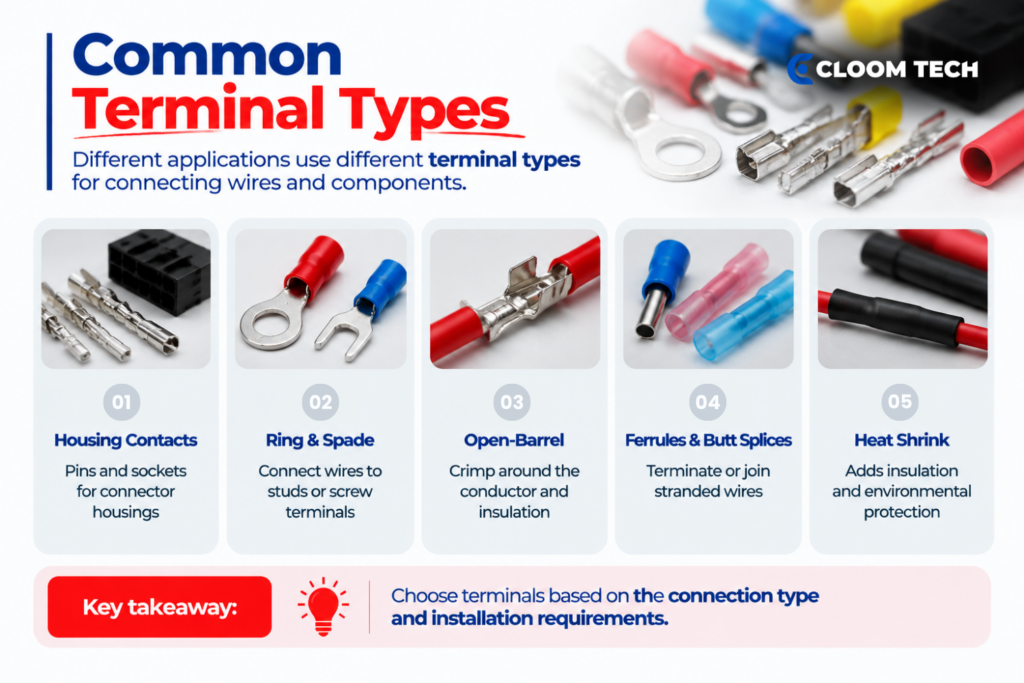
A customized assembly may incorporate several terminal types, depending on how its circuits connect to housings, studs, tabs, or other wires:
- Housing contacts: A male terminal uses a pin contact, and a female terminal uses a socket or receptacle contact.
- Ring and spade terminals: These wiring terminals connect conductors to studs or screw terminals within equipment.
- Open-barrel contacts: These crimp terminals fold conductor wings and insulation wings around the prepared wire.
- Ferrules and butt splices: Ferrules terminate stranded wire for clamp connections, and butt splices join conductors within an assembly.
Insulated and non-insulated terminals suit different installation conditions, with heat shrink protecting exposed barrels when the approved specification requires added insulation or environmental protection.
Match the terminal to the connector series
Connector housings accept approved contacts with defined wire ranges, so the electrical terminal must match the housing series and wire gauge. A different terminal with a similar appearance may use another locking geometry, contact size, or compatible insulation diameter.
Use the manufacturer’s terminal part identifier for each cavity, then state the terminal plating, seal, and required cavity plug. Common terminal materials include copper alloys chosen for conductivity and spring performance, with the specification identifying the required surface finish.
The right terminal establishes the intended electrical contact at the mating interface. Its geometry controls the usable contact area and normal force, which affect resistance, heat generation, and long-term connection stability.
Account for crimping and retention requirements
The connector systems in this guide typically use open-barrel crimp connectors installed with qualified tooling. Conductor wings form the electrical crimp as insulation wings support the wire, and the terminal barrel must match the specified conductor and insulation range.
Crimp quality depends on controlled wire stripping and tooling setup, with pull-force checks and crimp-height measurements confirming the process against the contact manufacturer’s requirements. When properly formed, terminal crimps keep conductor strands within the intended crimp zone.
After crimping, the contact must seat fully in the housing, with the specified lance, secondary lock, or assurance feature providing terminal locking where applicable. The wire crimping standards guide explains related workmanship requirements for wire harness terminals.
Connector-Family Comparison Table
Deutsch, TE Connectivity, Molex, and JST represent common types used in customized assemblies, giving teams selecting wire harness components a practical initial comparison. The final connector types used must match approved series-level components and customer drawings.
| Connector family | Typical applications | Why a buyer would specify it | Role within a custom harness or cable assembly |
|---|---|---|---|
| Deutsch | Outdoor equipment and transportation systems | Sealed housings, retention features, and options for demanding movement | Forms a customer-specified sealed or ruggedized interface |
| TE Connectivity | Control modules, equipment, and appliance connections | Broad sealed and unsealed portfolios for board, wire, or device interfaces | Matches the specified connection format and environmental protection |
| Molex | Appliances, computing systems, and automation equipment | Compact power options with varied pitches and current capabilities | Balances packaging space with circuit and mating requirements |
| JST | Internal electronics and compact control boards | Small-pitch options for signal or lower-current connections | Provides a customer-specified internal board or wire interface |
How to Specify Connectors and Terminals for Your Custom Harness Quote
A complete quote package should define the connector and terminal combination within the full assembly. Include the following information so sourcing, tooling, and production planning follow the specification:
- Housing identification: Provide the manufacturer and housing part number, with the family and series identified.
- Contact specification: List the contact identifier and wire range, followed by the required plating.
- Circuit information: Supply the cavity map and pinout, then attach the wire schedule.
- Environmental requirements: State the temperature limits and sealing needs, including moisture, dust, or chemical exposure.
- Mating details: Identify the mating housing or header and its approved keying.
- Production requirements: Include test criteria and expected quantities, along with approved-alternative rules.
This comprehensive information allows us to accurately source the specified components and prepare the necessary tooling for your assembly.
A complete quote package lets us review your specifications before manufacturing a customized wire harness or cable assembly. At Cloom Tech, we build assemblies to the connector and terminal requirements in your existing drawings, with DFM feedback to support material choices, cost control, and production efficiency.
Need a customized wire harness or cable assembly for your next project? Get a free quote here.
Wire Harness Connector & Terminal Types FAQs
What is the difference between a connector family and a terminal type?
A connector family defines a compatible system of housings, contacts, and mating components, whereas a terminal type describes the conductive part attached to the wire. The housing determines which contacts it accepts, so you need to specify both elements as a compatible combination within the customer-defined assembly.
How do I choose between Deutsch, TE Connectivity, Molex, and JST connectors?
Compare the application requirements, operating environment, and required pin count before considering packaging space, sealing, and mating format. Because capabilities vary among series within each brand, the final choice must match the approved components and interface shown in your drawings.
What information should I include in a custom harness quote request?
Provide the connector family, terminal connector types, application requirements, operating environment, pin count, and existing drawings. The housing and contact identifiers should match the cavity map, wire schedule, and mating components.
How does DFM feedback support connector selection?
Using your existing drawings, DFM feedback can identify incomplete component identifiers, incompatible wire ranges, and production access constraints. You provide the original requirements and completed drawings, and the review supports consistent production, material choices, and cost control within your approved specification.
Can Cloom Tech supply connectors separately?
We incorporate specified connector housings and terminals only into completed customized wire harnesses and cable assemblies. Send us your existing drawings and component identifiers with the harness quotation.
Back to Top: Wire Harness Connector & Terminal Types: A Buyer’s Selection Guide