OEMs often see double-digit differences between harness quotes for the same drawing, and the gap rarely traces back to any individual line item. Most quotes bundle materials and labor into a flat price, hiding where the real cost actually sits inside the harness.
Without that visibility, procurement negotiates piece price while the underlying drivers go untouched, and savings often stay stuck in the low single digits. A structured wire harness cost breakdown separates the five cost factors and shows OEMs which ones the specification permanently fixes—and which ones still respond to configuration and sourcing changes that can unlock 15–40% savings on the right programs.
What this Guide Covers
B2B Manufacturing Scope
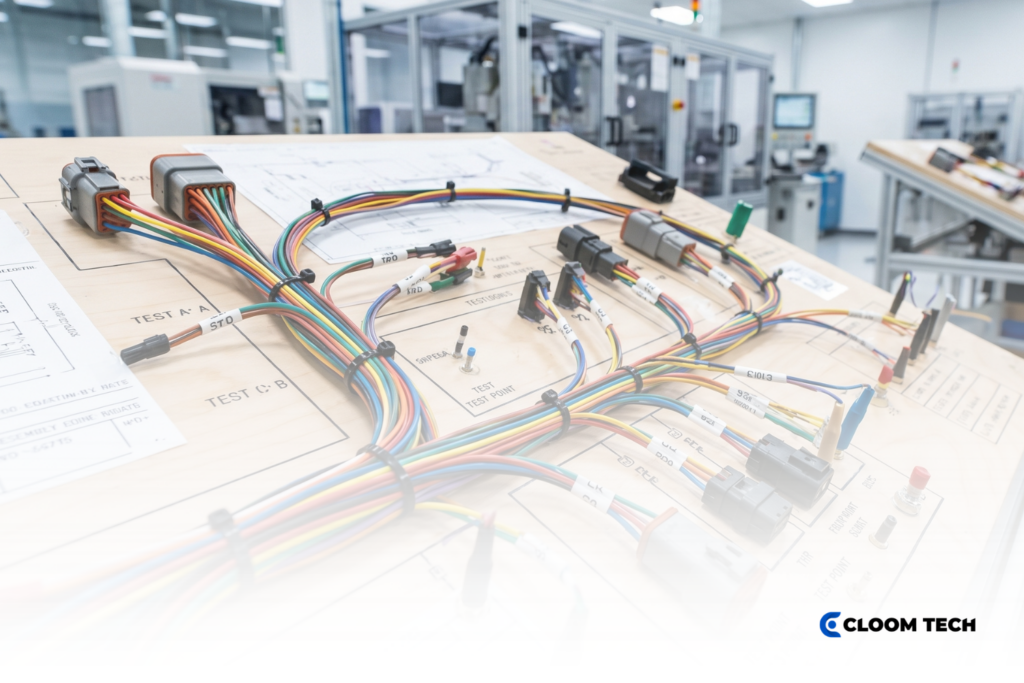
The scope is B2B custom wire harness manufacturing for OEM programs – not consumer repair or aftermarket replacement. Suppliers build quotes from materials, labor, and overhead, and OEM choices in configuration and sourcing move every line. Harnesses covered here are built to OEM drawings and performance specifications across automotive and industrial platforms, with cost sitting inside lifetime program economics rather than a single transaction.
Programs move through upfront NRE before pilot builds begin, then ramp into steady-state production at target annual volumes.
Who Should Use This Guide
Procurement staff, electrical engineers, and program owners inside an OEM team each touch a different part of the harness spend:
- Procurement staff – own the RFQs, supplier qualification, and price negotiations across regions.
- Electrical engineers – shape harness architecture, define routing paths, select gauges, and specify connector families.
- Program owners – need clear reasoning when one supplier quote comes in well above or below a competing bid.
How to Read the Cost Model
Percentages and ranges are directional, drawn from typical harness programs across multiple industries. Map the five factors against your own BOM and volume forecast to find where spending actually concentrates. A power-heavy harness pulls cost into copper, while a dense signal harness pushes spend toward connectors and test points. Later sections separate the levers that still move after launch from those reserved for the next major revision.
The Five Main Cost Drivers in Custom Wire Harness Manufacturing
Custom harness unit cost rolls up from five factors built into every program quote. Copper and wire content sit at the base, with connectors and labor close behind. Testing and tooling round out the model.
1. Copper and Wire Materials
Circuit count and gauge selection set the total copper mass on any harness across automotive and industrial builds. Routing distance adds the third multiplier. Power-heavy builds with parallel conductors quickly drive up consumption. Insulation choice then layers on top of that base copper figure—up-spec jackets covering high-temperature or halogen-free duty raise the cost per meter above standard PVC. Shielding adds another increment.
2. Connectors and Terminals
Basic open-barrel terminals cost a few cents per position on a standard commercial BOM. Sealed or high-reliability connectors land in the tens of dollars each, often dominating wire harness costs on dense builds. Pulling in many unique connector families increases the number of seals and backshells, and each family demands its own crimp tooling. Over-specifying sealing or pin count beyond the application need inflates the BOM with no functional gain.
3. Labor for Assembly and Testing
Operators still perform most cutting, stripping, crimping, and routing by hand across the build floor on standard programs. Automation handles a slice of the cut-strip-crimp process, but the final build remains largely manual. Added branches and overmolds raise the step count per harness. Splices push build minutes higher. Regional wage rates set the floor on cost per minute, while operator training and process control determine actual yield.
4. Quality Testing and Compliance
Every harness needs continuity and basic insulation checks before shipment. Test scope then scales with the end application and the standard in play:
- Continuity checks catch open circuits, shorts, and mis-terminations on standard commercial builds.
- Automotive and regulated sectors add visual criteria, full lot traceability, and serial-level records.
- High-risk programs run 100% hi-pot testing or functional verification rather than sample-based checks.
5. Tooling, Setup, and Non-Recurring Engineering (NRE)
New programs require terminal applicators and crimp dies before the first production unit ships. Test fixtures and formboards follow alongside work instructions tailored to the build. These upfront expenses spread across the expected production volume—the same NRE charge looks significant at prototype scale and modest across tens of thousands of units. Specification decisions that introduce many small harness variants multiply the number of setups and fixtures, making variant rationalization a recurring lever inside any wire harness cost breakdown.
Wire Harness Cost Split: Where Does the Money Actually Go?
Materials and labor account for most of the unit cost in a typical harness program. The exact split between copper and connectors varies by application, and the labor share shifts with build complexity.
Typical Cost Percentage Ranges
- Wire, plus connectors and accessories, often makes up the largest portion of the cost on standard OEM harnesses.
- Copper can reach a third to half of the materials bucket on long, power-heavy harnesses with parallel conductors.
- Connectors dominate the materials share on dense, modular harnesses built around sealed families.
- Assembly and test labor typically falls in the 25–40% range for complex manual builds.
- Testing infrastructure, NRE, and overhead absorb the remaining unit cost.
Example Cost Split by Harness Type
The table below covers a build with moderate circuit count, standard commercial connectors, and steady production volume alongside a complex electrified build. Use these as reference points against your own program data.
| Cost Category | Low-to-Mid Complexity Harness | Complex Electrified Harness |
|---|---|---|
| Wire and copper | 25–35% | 18–25% |
| Connectors and terminals | 20–30% | 30–40% |
| Assembly and test labor | 25–35% | 20–28% |
| Testing and QA | 5–10% | 10–15% |
| Tooling and overhead | 5–15% | 5–10% |
Sealing requirements and pin density pull more share into connectors on electrified builds. Tighter test coverage lifts the QA line, and wire harness cost estimation on dense platforms reflects that shift directly in supplier quotes.
Getting a structured cost breakdown before committing to a supplier quote helps identify where the real savings are. Request a free quote from Cloom Tech and receive a transparent breakdown across materials, labor, and testing for your program.
How Harness Specification Choices Affect Unit Cost
Every major specification decision in a harness moves both material and labor in the cost breakdown. Circuit count and connector type pull the heaviest weight on line item totals. Simpler architectures cut more cost than aggressive sourcing alone.
Circuit Count and Harness Complexity
Each added circuit increases wire length and adds extra terminations to the BOM. Test points multiply in step with new connector cavities. Complex branching pushes routing difficulty higher across the formboard, and tight spaces raise rework risk when junctions stack. Programs that audit circuit value early often reduce signal counts without sacrificing functionality—wire harness costs drop measurably when low-value circuits are pruned before tooling.
Wire Gauge, Insulation, and Special Cable Types
Larger cross-sections consume more copper per meter, lifting raw material spend and finishing harness weight. High-spec insulation adds a premium on top, and shielding adds another layer of cost while making routing harder on tight runs. The right approach is to select the smallest gauge that still meets the electrical duty and insulation rated for actual environmental conditions rather than a blanket up-spec.
Connector Families, Sealing and Terminal Types
Choosing multiple connector series across a platform increases SKUs and the need for dedicated crimp tooling and expands operator training requirements. Sealed connectors specified on routes with no genuine moisture exposure add assembly steps with no field benefit. Rationalizing to a small set of families concentrates volume across the BOM—wire harness cost estimation improves when terminal types narrow and the same crimp tooling runs across multiple harnesses.
Overmolding, Strain Relief, and Protection
Protection adds material and installation time to every interface it covers. The level should match actual route conditions rather than default to maximum coverage:
- Overmolded junctions and cable ends require mold tooling plus added material per interface.
- Corrugated tubing and braiding each add their own installation step on the build floor.
- Matching protection to actual vibration and exposure risk avoids paying for cosmetic ruggedization on benign routes.
Documentation Quality and DFM Readiness
Complete drawings and clean BOMs reduce interpretation time on the production floor. Routing details remove guesswork at the workstation. Poor documentation drives quote padding and extra clarification cycles during early builds. Manufacturability feedback strips out complexity before tooling commits to a specific configuration—a tight document pack reduces the wire harness cost breakdown by cutting rework and shortening the path from RFQ to first-article approval.
How Volume Affects Unit Cost
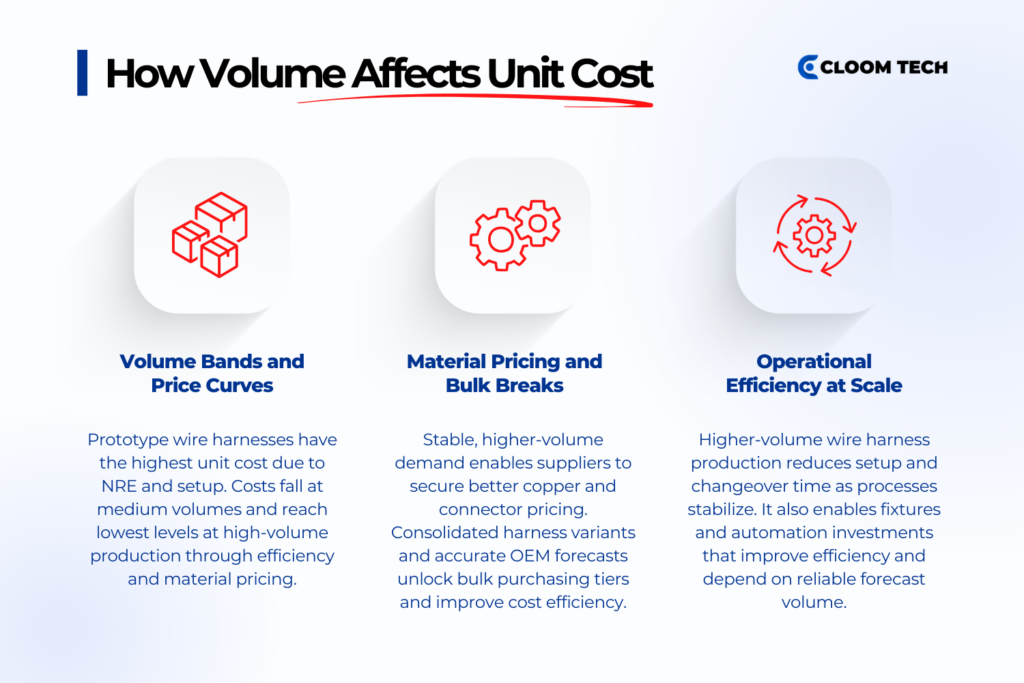
Annual volume sets the per-unit weight of every fixed cost in the wire harness cost breakdown. Tooling, setup, and documentation spread thinner as program quantities rise. Higher volumes also strengthen a supplier’s leverage on copper and connector pricing.
Volume Bands and Price Curves
Prototype quantities in the single digits up to a few dozen carry the highest unit costs. NRE, setup, and operator learning curve sit on every harness because none of those expenses amortize at low quantities. Low-to-medium volume in the tens to low thousands typically delivers the first meaningful price break—setups stabilize, and materials move in larger batches. High volume at tens of thousands and above supports fine-tuned work instructions, dedicated stations, and aggressive material pricing, bringing wire harness costing to its lowest unit figure.
Material Pricing and Bulk Breaks
Suppliers can’t negotiate strong copper and connector pricing without higher, more stable usage commitments with their own upstream sources. Demand aggregated across similar harness families unlocks larger spool buys at improved price tiers. Standardized connector orders follow the same bulk pricing logic. OEMs that consolidate variants and supply realistic forecasts help their suppliers reach those purchasing thresholds—forecast accuracy matters as much as raw volume, since suppliers can’t lock favorable pricing on demand they can’t rely on.
Operational Efficiency at Scale
Repetition cuts assembly time as operators and supervisors refine routing, crimping, and inspection steps across thousands of builds. Larger, more consistent runs reduce changeovers and partial setups, trimming wasted floor time. Stable high volume also justifies investments in specialized fixtures or partial automation that wouldn’t pay back at low quantities – a choice that ties directly to forecast confidence.
How Country of Manufacture Affects Your Total Cost
Labor rates and tariffs both feed into the landed cost behind any wire harness cost breakdown. Low hourly wages don’t translate to the lowest unit cost when quality or freight risk offsets the savings—country choice changes the entire cost mix.
Labor Rate and Productivity Differences
Regions with lower wages can offer cheaper assembly time on paper. Training depth and process quality determine how many good harnesses actually ship per hour from those lines. Higher-wage regions often stay competitive through better automation and tighter process control, with lower rework rates. The effective labor figure in wire harness costing depends on both the hourly rate and the first-pass yield—a cheaper line losing 8% to rework can land above a higher-priced line running at 99% yield.
Tariffs, Duties, and Logistics
Duties and freight quietly absorb a meaningful share of the savings buyers expect from offshore sourcing on most programs:
- Tariffs on finished harnesses or key inputs like copper can shift the effective cost of imports from certain countries.
- Freight cost and customs complexity vary by trade lane and feed directly into total landed cost.
- Programs that exclude duties and logistics from wire harness cost estimation routinely underestimate the true cost of offshore production.
Reshoring and Nearshoring Cost
Moving harness work from a high-tariff country to a closer or lower-tariff region can offset higher labor rates. Whether the wire harness cost breakdown improves depends on the balance between labor and tariff exposure for the specific program. Some OEMs split harness families by complexity and geography—simple, labor-heavy builds stay in lower-cost regions, while critical or complex assemblies shift closer to end use for tighter control.
5 Strategies OEMs Use to Cut Wire Harness Costs by 15–40%
Big reductions in the wire harness cost breakdown rarely come from a single lever. Real savings result from harness simplification, standardization, smarter sourcing, and volume strategy. The five strategies below are best applied at design freeze or the next major revision point.
Strategy 1: DFM Review for Harness Simplification
A focused DFM review of existing harness definitions removes unnecessary branches and excess wire length. Redundant connector variants drop out alongside them. The wire harness cost breakdown shows the steepest reduction when simplification happens before tooling commits to a specific configuration. Simplified layouts shorten routing paths, reduce termination counts, and lower test point totals. Bringing manufacturability input early prevents quality issues from being locked into the harness for the program’s full life.
Strategy 2: Connector and Component Standardisation
Standardization across a small set of connector families concentrates volume on a narrower BOM and reduces wire harness costs by lowering inventory complexity. Training and crimp tooling consolidate around that shortlist; one-off connectors drop off, and changeover time shrinks accordingly. Standardization also improves part availability across suppliers because fewer unique items mean fewer potential sourcing bottlenecks. Schedule risk falls measurably once a program standardizes its connector strategy across model variants.
Strategy 3: Material Substitution Where Specifications Allow
Equivalent wires and insulations that meet the same electrical and environmental requirements can replace premium options without altering the harness’s performance intent. Programs that classify each harness segment by actual duty gain real flexibility in wire harness cost estimation – sealed connectors stay where moisture risk justifies them, standard housings cover benign routes, and selective substitution avoids blanket downgrades that introduce field risk later.
Strategy 4: Volume Consolidation and Forecasting
Consolidating similar harness variants and aligning release dates increases run sizes and improves material efficiency. Forecast accuracy carries equal weight with raw volume on the wire harness cost breakdown. Clear forecasts let suppliers plan capacity and negotiate better raw material deals upstream, while last-minute expedite costs fall away. Combining harness demand across models or platforms can move the program into more favorable price tiers.
Strategy 5: Supplier-Side Bulk Procurement and Dual Sourcing
Supplier-side bulk procurement across multiple customers secures wire harness costs on copper and connectors that any single OEM can’t achieve alone through direct negotiation. Network scale unlocks pricing tiers that piece-price negotiation rarely reaches. Dual sourcing by region hedges tariff exposure on long-running programs while reducing freight risk in the same move. Leveraging supplier network strength in materials and geography often delivers more savings than direct negotiation alone.
Cloom Tech’s procurement network and dual-location model give OEM programs access to bulk material pricing and geographic cost flexibility that single-source arrangements can’t match. Contact Cloom Tech to discuss a DFM review or cost reduction assessment for your wire harness program.
How Cloom Tech’s DFM Review and Procurement Model Reduces Your Unit Cost
Cloom Tech manufactures custom wire harnesses strictly to your drawings. The manufacturability review on each drawing package flags excess branches and over-built protection before tooling commits. Feedback stays within your original requirements rather than reshaping the build on the production line.
Global procurement through established long-term partners tightens the wire harness cost breakdown by reaching copper and connector pricing tiers that no single buyer can secure alone. ISO 9001 and IATF 16949 certifications drive a high first-pass yield across manufacturing floors in both China and the Philippines. Multi-region production also offsets tariff exposure across each program, giving OEM procurement teams a practical tool for total landed cost management.
Wire Harness Cost Breakdown FAQs
When is the best time to involve a harness supplier in the process?
The best window is once your schematics and rough routing are defined, but before design freezes. Supplier input at that stage refines connector families and branch structure while changes are still cost-effective. Waiting until after freeze locks avoidable cost into the wire harness cost breakdown for the life of the program.
What does a strong harness drawing package include?
A strong package includes clear harness drawings paired with specified connector families on the BOM. Wire gauges, insulation, and shielding benefit from part-number-level documentation. Test requirements should match the actual application rather than default to maximum coverage. Clarity at that level drives faster quoting and cleaner first articles at launch.
How can I match harness specs to real application needs?
Classify each harness segment by environment, mechanical stress, and criticality. Connector sealing and cable rating then align with those conditions rather than blanket coverage. Test depth follows the same logic: premium materials stay focused where they earn their place, which sharpens wire harness costing without introducing field risk.
How can I effectively benchmark my current harness pricing?
Choose one or two representative harnesses and share identical RFQ packages with a shortlist of qualified suppliers. Each package needs the same drawing depth, BOM detail, and test scope. Aligned inputs let you compare quotes directly on materials, labor, and logistics—the only fair basis for wire harness cost estimation.
Back to Top: Wire Harness Cost Breakdown: What Drives Price and How OEMs Cut 15–40%