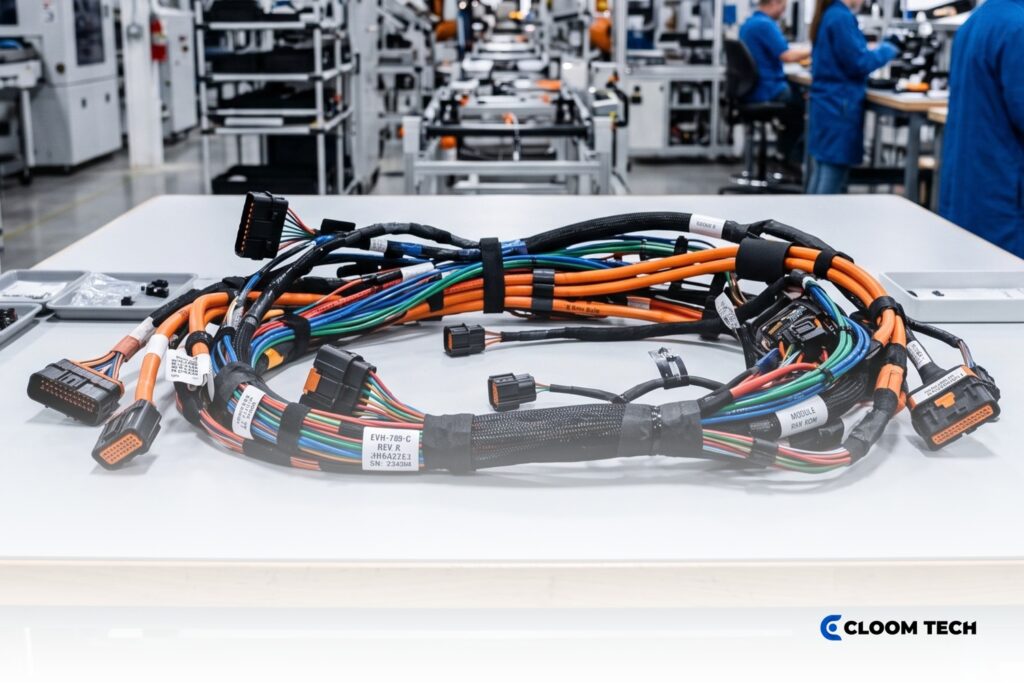
You’ll often encounter references to several wire harness standards on capability pages, qualification records, and quotation documents, and each reference can cover a different area of compliance. Some requirements address workmanship and acceptance, substance restrictions, or general quality management.
Other standards address automotive quality management or safety-related product, component, and market requirements. For example, RoHS restricts hazardous substances in covered equipment, including relevant cables and spare parts within its legal scope.
A wire harness certification claim becomes useful when its scope matches the manufacturing site, application, and purchasing requirements. This compliance roadmap connects each requirement to its purpose, so you can verify credentials before approving a supplier or moving a project into production.
IPC/WHMA-A-620 Explained
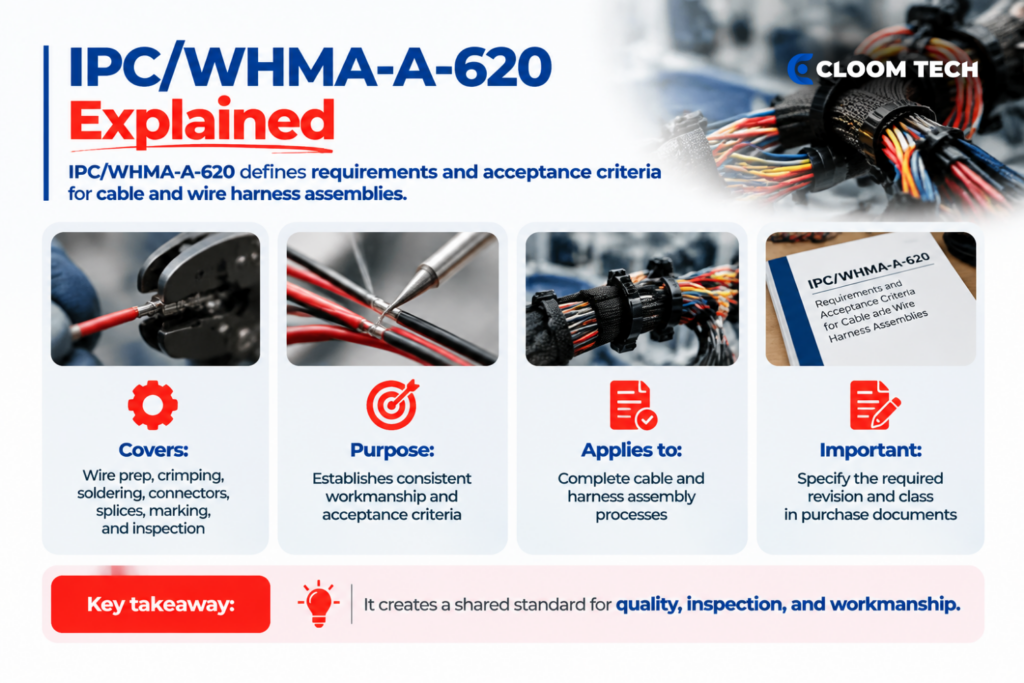
IPC/WHMA-A-620F, formally titled “Requirements and Acceptance for Cable and Wire Harness Assemblies,” establishes requirements for materials, methods, tests, and acceptance criteria. It belongs to an official family of standards and addenda that supports consistent application. You can use its acceptance language to align drawings, purchase orders, inspection criteria, and supplier expectations.
What the workmanship standard covers
IPC/WHMA-A-620 applies to activities such as wire preparation, crimped and soldered terminations, connector installation, splices, marking, securing, and finished-assembly inspection. Its requirements give operators, inspectors, and customers a shared basis for deciding whether completed work meets the specified class and acceptance criteria.
The standard supports the complete cable and wire harness assembly rather than serving as a general product-safety approval. It can guide wire cutting and stripping, termination quality, and inspection of exposed wire ends. A wiring diagram alone may describe circuit relationships without establishing workmanship acceptance requirements. Your purchase documents should identify the required revision and class.
Why acceptance criteria matter to you
Consistent acceptance criteria reduce interpretation differences between you and the manufacturer. They also support process control by connecting work instructions, inspection methods, and rejection criteria to an agreed requirement. The common industry-consensus workmanship standard provides a shared reference for original equipment manufacturers and electronics manufacturing services providers.
A credible wire harness certification statement should identify whether it concerns personnel credentials, organizational capability, or conformance of a particular assembly. Verify the revision, class, site, and scope before treating any standard name as a universal approval. You can review the buyer-focused IPC standard explanation for additional internal context.
RoHS Explained
The Restriction of Hazardous Substances Directive, commonly called RoHS, limits specified substances in covered electrical and electronic equipment placed on the European Union market. RoHS functions as a legal restriction framework rather than a workmanship certification for harness assembly.
What the restriction covers
RoHS limits 10 substances in covered equipment, including lead, cadmium, mercury, hexavalent chromium, and several flame retardants and plasticizers. The restrictions apply to electrical and electronic products unless an exclusion or exemption applies. The directive also covers qualifying cables and spare parts within its defined legal scope.
Material declarations may address conductors, insulation, terminals, plating, labels, and protective materials used in a harness. Choosing copper or aluminum doesn’t establish compliance by itself, since the applicable limits concern restricted substances within materials and components. You should connect the bill of materials, supplier declarations, and applicable exemptions to the finished product’s market placement.
How to assess RoHS claims
A RoHS statement should identify the product or material covered, the directive version used, and the evidence supporting the declaration. You may request material declarations, required test reports, and traceability records that connect approved materials to harness production. Those records support regulatory compliance and help ensure the customer’s documented substance requirements are met.
RoHS relevance depends on the product category, destination market, and applicable exclusions. You can review these RoHS requirements for wire harnesses for additional application context. European Union legislation remains the authority for determining legal scope.
ISO 9001 Explained
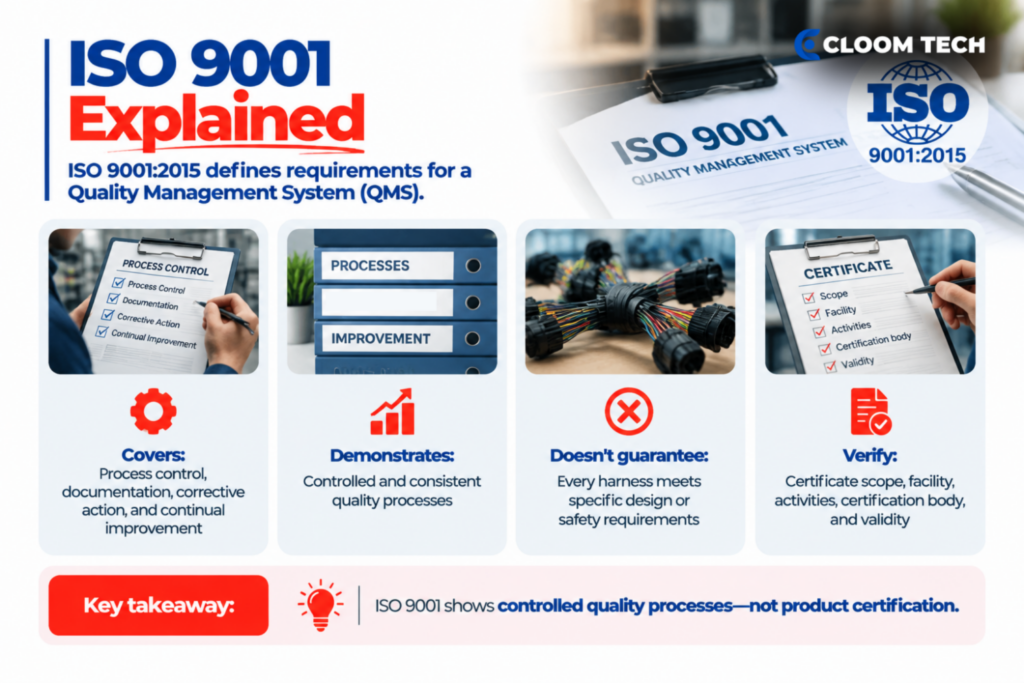
ISO 9001:2015 specifies requirements for a quality management system (QMS). It establishes requirements for managing processes, documented information, and corrective action. The standard also addresses continual improvement rather than certifying the safety and performance of each harness.
What a quality management system demonstrates
An ISO 9001 QMS addresses leadership, customer focus, process planning, documented information, performance evaluation, and continual improvement. Organizations in many sectors can apply ISO 9001 quality-management requirements, which makes the standard relevant beyond one product category or industry vertical.
ISO 9001 indicates that a certified organization has established controlled processes within the certificate’s stated scope. You can assess whether those controls govern purchasing, training, nonconforming output, corrective action, and changes to the manufacturing process. It is important to understand that the certification doesn’t prove that every proposed harness meets its drawing, testing standards, or application requirements.
How to verify the certificate scope
You should review the legal entity, certified location, covered activities, issuing certification body, accreditation details, and validity dates. The certificate scope should include the facility and relevant manufacturing systems responsible for the quoted work. ISO doesn’t certify organizations directly; independent certification bodies conduct the audits.
You can use the comparison of three quality management standards when evaluating quality management requirements.
IATF 16949 Explained
IATF 16949 adds automotive-sector quality management requirements to ISO 9001:2015. It addresses the needs of the global automotive industry, and you should evaluate it alongside customer-specific program requirements.
How IATF 16949 relates to ISO 9001
IATF 16949 replaced ISO/TS 16949:2009 as the automotive sector’s quality management standard. It builds on ISO 9001:2015 rather than replacing it; organizations must satisfy both simultaneously. IATF 16949 adds automotive-specific requirements on top of the ISO 9001 foundation, covering areas such as product safety, supply chain management, and customer-specific obligations from individual OEMs.
Those customer-specific requirements matter in practice. Ford, GM, Stellantis, and other OEMs each publish their own supplementary rules that sit on top of IATF 16949 itself. Holding the certification doesn’t automatically satisfy every OEM’s program requirements: you’ll need to confirm which customer-specific documents apply to your program and verify the manufacturer has addressed them.
What to verify for automotive work
For automotive work, you should confirm the certificate’s manufacturing-site scope, validity, and recognized certification body. You should also identify the customer-specific requirements that apply to your program. IATF 16949 certification alone doesn’t resolve every original equipment manufacturer obligation.
Program documentation may connect feasibility review, control plans, approval records, and production evidence. The manufacturing team needs controlled customer drawings, specifications, and change histories.
UL Certification Explained
UL terminology can describe different evaluations, including listed products, recognized components, and program-specific certification coverage. You should identify the applicable category instead of treating “UL certified” as one universal status.
Product, component, and program status differ
UL Solutions evaluates wire and cable categories against applicable safety standards, performance requirements, and compliance criteria. An UL-recognized wire or connector doesn’t automatically make the completed electrical harness UL certified. The finished product, component, and participating manufacturing program may each have a different scope.
The UL wiring harness traceability program monitors cables as they move from manufacturing plants to harness producers and final assembly. Participation and eligibility depend on UL’s program requirements. Manufacturer-specific verification requires the corresponding UL records and clearly defined program scope.
How to evaluate a UL claim
You should request the UL file number, category, covered facility, applicable construction, and authorization for any mark. The proposed wire type, insulation, connectors, ratings, and end-product requirements may affect whether a particular assembly fits the claimed coverage.
Project documentation should distinguish component recognition, finished-product certification, and market requirements. You can verify manufacturer-specific certification status in current UL documentation against the relevant category and program scope.
Standards-Applicability Matrix by Industry Vertical
For automotive work, you’ll typically prioritize IATF 16949, ISO 9001, and IPC/WHMA-A-620. The product and market determine whether RoHS and UL requirements apply. For industrial and medical work, you’ll commonly evaluate IPC/WHMA-A-620 and ISO 9001 first.
Telecommunications and consumer electronics projects often begin with the same review. Ultimately, your selected standards must align with the specific application, destination market, and customer requirements.
| Industry vertical | IPC/WHMA-A-620 | RoHS | ISO 9001 | IATF 16949 | UL certification |
|---|---|---|---|---|---|
| Automotive | Often relevant for assembly workmanship and acceptance. | Relevant when covered equipment, markets, or customer specifications require substance controls. | Broadly relevant for QMS review. | Primary automotive-sector QMS reference when the program and supply-chain position require it. | Applicable when components, products, or target markets require specific UL coverage. |
| Industrial | Often relevant for harness workmanship and inspection. | Depends on equipment scope, destination market, and customer requirements. | Commonly relevant for evaluating organizational quality controls. | Usually limited to automotive supply-chain work within an industrial manufacturer. | Depends on equipment standards, component status, and end-use certification needs. |
| Medical | Relevant when customer specifications invoke its workmanship criteria. | Relevant for covered equipment and applicable market requirements. | Useful for general organizational quality controls. ISO 13485 may separately apply within the medical-device compliance landscape. | Relevant when the same operation supplies qualifying automotive work. | Depends on the device, components, market, and product-safety pathway. |
| Telecommunications | Useful when purchase documents specify harness workmanship requirements. | Relevant for covered electronic equipment placed on applicable markets. | Useful for evaluating repeatable organizational controls. | Relevant only to qualifying automotive-related programs. | Depends on the equipment category, components, and target market. |
| Consumer electronics | Useful when assembly acceptance criteria require it. | Relevant when the product falls within the RoHS scope and enters an applicable market. | Useful for assessing process consistency and corrective-action systems. | Limited to qualifying automotive supply chain operations. | Depends on product category, component recognition, and market requirements. |
How to use the matrix
You should begin with the product’s destination markets, customer specifications, intended use, and applicable regulatory pathway. You can then translate those requirements into drawing notes, purchase-order clauses, and evidence requests. This method prevents a broad wire harness certification statement from replacing project-level verification.
Technical documentation should connect each invoked requirement to the relevant assembly characteristics. A complete package may include controlled drawings, a defined harness layout, wire routing requirements, inspection criteria, and test records. Properly scoped harness solutions connect those documents with applicable manufacturing standards.
The following checks help you assess the practical value of claimed international standards and certifications:
- Confirm the exact scope: Match the certificate, declaration, or program listing to the legal entity, manufacturing site, and proposed work.
- Connect requirements to documents: Identify where the drawing, specification, or purchase order invokes applicable technical standards and acceptance criteria.
- Review production evidence: Determine whether inspection records, material traceability, and electrical testing demonstrate conformance for the delivered assembly.
- Separate related activities: Distinguish customer-controlled product requirements, manufacturing review, assembly responsibilities, and independent certification decisions.
- Assess application performance: Connect workmanship and material requirements to expected harness reliability, operating conditions, and specified testing.
Medical-Vertical Compliance Note
For regulatory purposes, ISO 13485 specifies medical-device QMS requirements. You may encounter the standard when evaluating a medical-device supply chain.
ISO 13485 belongs in the broader medical compliance landscape, but its applicability depends on the organization’s role, certificate scope, and regulatory pathway. You may need ISO 13485 in addition to workmanship, material, and product-safety requirements. The standard should not be presented as interchangeable with ISO 9001.
Request a Quote for Your Harness Project
Cloom Tech manufactures custom wire harnesses and cable assemblies from your drawings and specifications. We review your existing documentation for manufacturability and provide production-focused recommendations. Our confirmed certifications—ISO 9001, IATF 16949, and IPC/WHMA-A-620—cover the quality management and workmanship standards most commonly required across automotive, industrial, and commercial programs, so you can verify our credentials directly against your project’s compliance checklist. Contact us and get a free quote for your program.
Wire Harness Industry Standards FAQs
Which wire harness standards apply to my industry?
Applicable wire harness standards depend on the product, market, customer requirements, and manufacturing scope. IPC/WHMA-A-620 addresses workmanship and acceptance; RoHS controls restricted substances in covered equipment; ISO 9001 addresses quality management. IATF 16949 applies to qualifying automotive supply-chain activities, while UL requirements depend on the product, component, program, and market.
What does IPC/WHMA-A-620 cover?
IPC/WHMA-A-620 establishes requirements and acceptance criteria for cable and wire harness assemblies. You should specify the required revision and class, then connect those requirements to drawings, inspection criteria, and purchase documents.
Is RoHS a wire harness certification?
RoHS is a European Union legal framework restricting hazardous substances in covered electrical and electronic equipment. A declaration of conformity should identify the covered product and supporting material evidence rather than being treated as a general manufacturer certification.
How do ISO 9001 and IATF 16949 differ?
ISO 9001 provides general QMS requirements that organizations can apply across sectors. Qualifying automotive supply chain participants use IATF 16949 with ISO 9001 to apply automotive-specific QMS requirements.
How should you verify certification claims?
You should match each claim to its certificate, declaration, file number, or program record. Verification should cover the legal entity, manufacturing location, scope, validity, and relevance to the quoted assembly. A recognized wire harness certification only supports your sourcing decision when its documented coverage matches the project’s requirements.
Back to Top: Wire Harness Industry Standards: A Buyer’s Compliance Roadmap