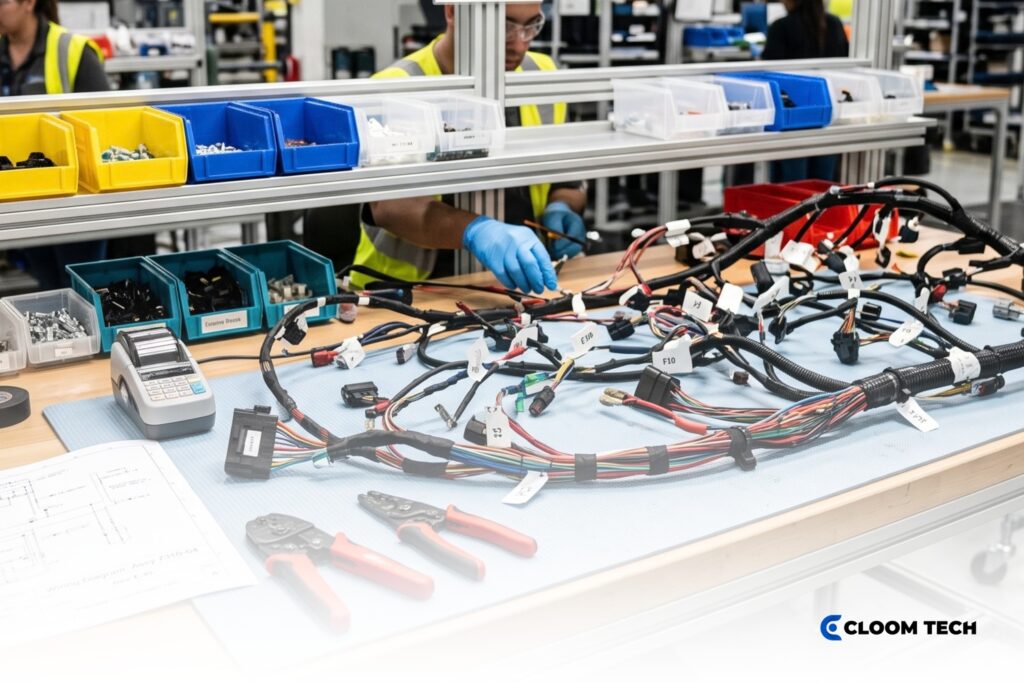
Procurement teams often use wire harness manufacturer and wire harness supplier interchangeably, although the terms can describe different sourcing relationships. A manufacturer performs and controls the production work required to build a harness. A supplier provides the finished product and may also resell or coordinate production through another company.
The distinction affects customization, scheduling, communication, and responsibility for manufacturing evidence. Understanding each company’s role helps you choose a partner whose capabilities align with your drawings, documentation requirements, and application risks.
What is a Wire Harness Manufacturer?
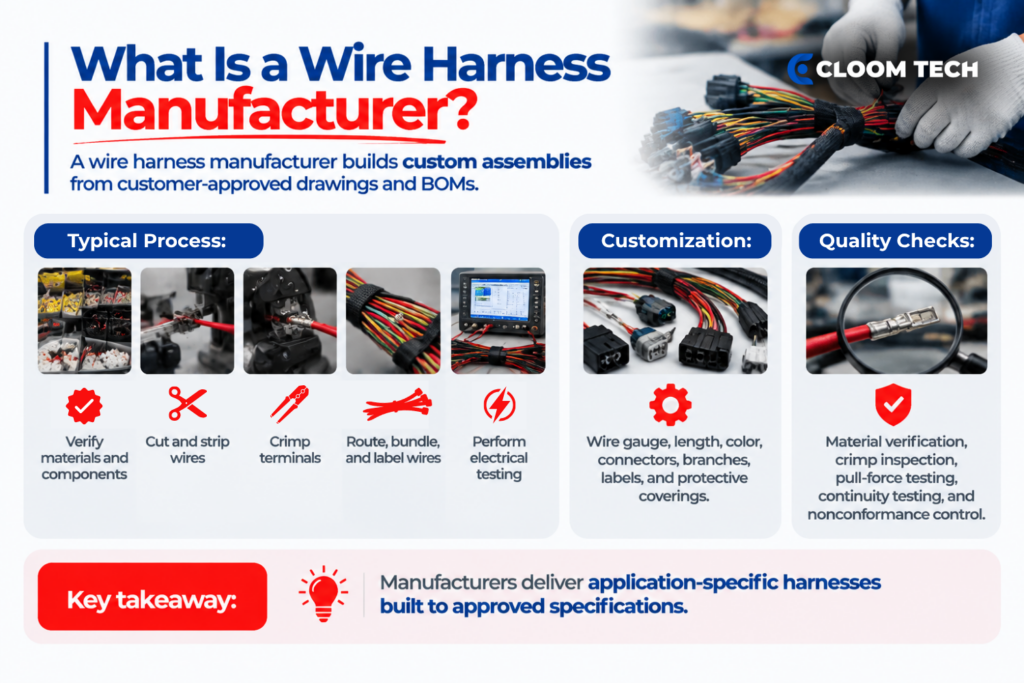
A wire harness manufacturer transforms specified wires, terminals, connectors, and protective materials into a finished assembly. Production follows the customer’s drawings, bill of materials, and documented acceptance requirements.
The manufacturer manages the operations required to turn those inputs into a repeatable product. Depending on the harness, the manufacturing process may include wire cutting, stripping, crimping, routing, bundling, and electrical testing.
Production takes place under direct control
Direct production gives the manufacturer responsibility for the people, equipment, and procedures used during harness manufacturing. The company manages the sequence of operations and maintains the documents needed to reproduce the approved configuration.
A typical production workflow may include:
- Material verification: Production teams confirm wire specifications, terminals, connectors, and bill of materials requirements before releasing components.
- Wire preparation: Operators cut and strip each conductor to the dimensions stated in the approved documentation.
- Terminal application: Calibrated crimping equipment joins the specified terminals to prepared conductors.
- Harness assembly: Technicians position wires on a fixture or form board before applying coverings, labels, and cable ties.
- Inspection and testing: The completed assembly undergoes the checks required by the drawing, contract, and applicable acceptance criteria.
The approved drawing controls the finished configuration, but work instructions translate its requirements into repeatable shop-floor operations. Production teams use those instructions to prepare conductors, apply terminals, and assemble branches consistently.
Manufacturers support drawing-based customization
A manufacturer builds the assembly from the buyer’s approved documentation. The drawing and bill of materials (BOM) establish details such as conductor specifications, connector part numbers, labels, and BOM-listed insulation materials.
Customization may cover:
- Branch lengths and breakout locations
- Connector and terminal selection
- Wire gauge, color, and identification
- Protective coverings and strain relief
- Label content and placement
- Electrical and mechanical test requirements
This production model suits buyers who need a custom wiring harness manufacturer to reproduce an application-specific configuration. It also accommodates controlled changes when the customer releases an approved drawing or BOM revision.
Manufacturing involvement doesn’t automatically include original product development. Build-to-print companies manufacture from existing customer drawings and may review those documents for manufacturability. The review can identify unclear dimensions, material availability concerns, or production constraints without transferring responsibility for the original design.
Inspection requirements follow the approved documents
Manufacturers use the drawing, purchase order, and inspection plan to determine the checks required for each assembly. Specified criteria may cover conductor preparation, terminal placement, crimp condition, and completed electrical connections.
Relevant production evidence may include:
- Incoming material verification
- Crimp-height measurements
- Pull-force test results
- Continuity test reports
- Approved deviation records
- Nonconformance and corrective-action records
The IPC/WHMA-A-620 requirements cover materials, methods, tests, and acceptance criteria for cable and wire harness assemblies. Buyers can identify the applicable class and revision in their purchasing documents.
Manufacturers may also operate under a quality management system such as the International Organization for Standardization (ISO) 9001. Automotive projects may require International Automotive Task Force (IATF) 16949 in conjunction with ISO 9001.
What is a Wire Harness Supplier?
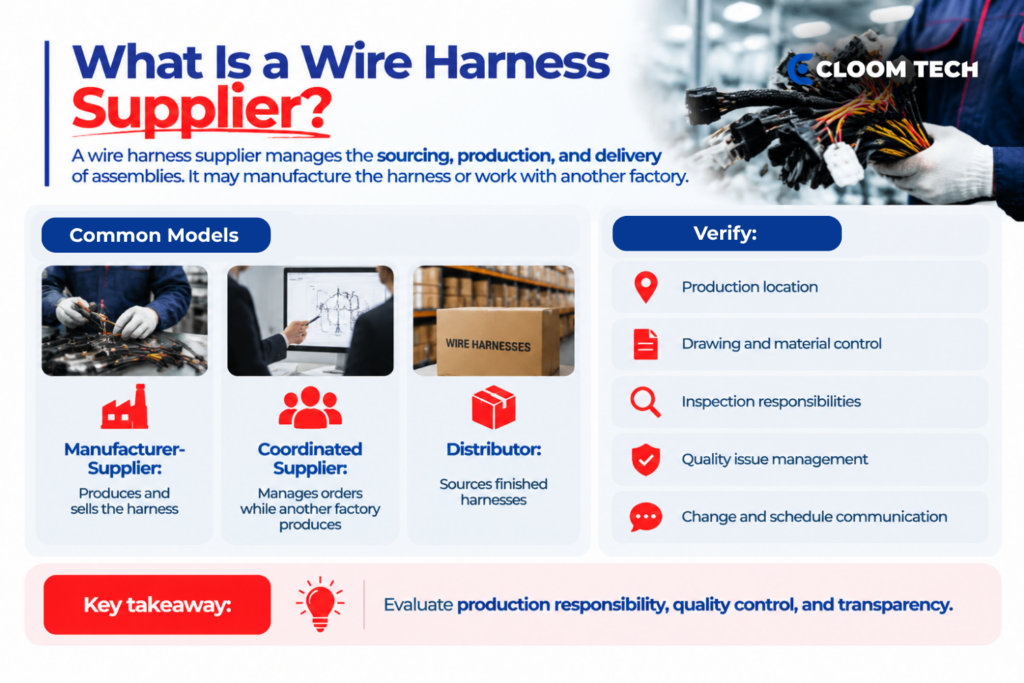
A wire harness supplier manages the commercial relationship through which the buyer receives the assembly. Its responsibilities depend on whether it manufactures the product, purchases it from another factory, or coordinates selected operations among approved companies.
The supplier label doesn’t establish where production occurs. Buyers should identify the actual operating model before assessing its suitability for the project.
Suppliers use several operating models
The roles within a supply chain distinguish companies that produce goods from those focused on supplying or distributing them. A supplier can also be a manufacturer when it performs the production work.
Common arrangements include:
- Manufacturer-supplier: One company manufactures the harness and manages the sale.
- Coordinated-production supplier: The supplier manages the order, but another company performs some or all production operations.
- Distribution-focused supplier: The company sources finished products and manages commercial orders or delivery without operating the production process.
Each arrangement can serve a legitimate purchasing purpose when the parties define their responsibilities. The buyer needs to know where production occurs, who authorizes changes, and which organization addresses manufacturing issues.
The project determines whether the model fits
A supplier relationship may suit a sourcing arrangement where the buyer prioritizes product availability or centralized purchasing. The arrangement can also support customized work when the supplier provides transparent production information and manages approved factories effectively.
The project becomes more demanding when an assembly includes multiple branches, detailed routing, or application-specific testing. Buyers should confirm that the supplier can communicate approved changes accurately and maintain alignment between the order documents and the producing facility.
Contract terms should identify the organization responsible for:
- Applying the approved drawing revision
- Purchasing authorized materials
- Managing process changes
- Conducting specified inspections
- Addressing nonconforming assemblies
- Communicating schedule updates
These responsibilities provide a more useful basis for comparison than the company’s chosen title.
Manufacturer vs. Supplier: The Differences
Production ownership influences how each business manages customization, scheduling, and manufacturing information. The following table summarizes the practical differences without assuming that every company uses the same operating model.
| Area | Manufacturer | Supplier |
|---|---|---|
| Primary role | Converts specified materials into a finished harness | Provides the harness under an agreed sourcing arrangement |
| Customization | Builds from approved drawings and BOM requirements | Depends on the capabilities available within its sourcing network |
| Technical communication | Connects questions with its production personnel | Coordinates responses with the company performing the relevant work |
| Change implementation | Updates its controlled production documents | Communicates approved revisions to the producing facility |
| Scheduling | Plans work using its capacity and material status | Coordinates timing with its sourcing or production partners |
| Manufacturing evidence | Generates records within its production system | Obtains required records from the responsible facility |
| Suitable purchasing context | Application-specific production with defined process requirements | Centralized sourcing or purchases that prioritize product availability |
Scheduling depends on capacity and materials
A manufacturer develops its production schedule from available capacity, approved materials, and order requirements. Drawing approval, component sourcing, or additional testing can affect the stated lead time.
Suppliers that use another factory must incorporate that facility’s schedule into the delivery plan. The purchase agreement should establish who provides timing updates and communicates any change affecting the agreed delivery date.
Tooling responsibilities require written agreement
Tooling ownership doesn’t automatically belong to the company performing production. The buyer, supplier, producing factory, or another party may own fixtures and application tooling, depending on the commercial agreement.
Purchasing documents should define:
- Tooling ownership
- Storage location
- Maintenance responsibility
- Replacement approval
- Access rights
- Transfer arrangements
Clear terms help each party understand its responsibilities if production volumes change or the commercial relationship ends.
Which One Do You Need?
Choose the sourcing model that matches your assembly’s complexity, documentation requirements, and application risk. Projects with customized configurations and specified manufacturing controls usually benefit from direct factory involvement. Availability-focused purchases may suit a supplier-led arrangement when responsibilities remain clearly documented.
Use manufacturing capability as the deciding factor
Company titles vary, so you should assess the capabilities attached to each proposal. A suitable partner should be able to perform or coordinate every operation defined by the approved production package.
Direct manufacturing involvement may suit a project that requires:
- Production from an approved drawing and BOM
- A prototype before volume release
- Application-specific fixtures or test equipment
- Controlled material substitutions
- Repeatable processing over a long program
- Defined inspection and acceptance criteria
A supplier-led relationship may suit a project that requires:
- Availability-focused sourcing where production complexity is low
- Centralized purchasing across multiple product lines
- Faster commercial onboarding when the producing factory is already qualified
- Flexible order volumes without long-term production commitments
- A single commercial contact managing multiple manufacturing sources
You’ll need to confirm that any supplier can communicate approved changes accurately to the producing facility and provide the same production records you’d expect from a direct manufacturer. The sourcing model is less important than whether accountability for drawings, materials, and inspection is clearly documented.
Buyers considering custom wire harness manufacturers should also confirm that available equipment suits the required wire gauges, terminals, and production volumes. A capable factory needs the correct application tooling rather than relying on general assembly experience.
Evaluate the proposed production arrangement
Your assessment should focus on the services required for the specific harness rather than a general list of company capabilities. Confirm which location will perform the work and whether the quoted scope covers every required operation.
Useful evaluation points include:
- Production scope: Identify the operations completed at the proposed facility.
- Certification scope: Confirm that relevant certificates cover the production site and requested service.
- Material control: Establish how the company purchases, verifies, and stores specified components.
- Testing capability: Check whether the facility has the equipment required by your approved inspection plan.
- Change management: Determine how the company applies drawing revisions and approved deviations.
- Capacity planning: Compare the expected production volume with the facility’s available resources.
These questions help buyers compare manufacturers based on the proposed work, rather than on broad marketing descriptions.
Match the relationship to the application
Application requirements should determine the level of manufacturing control a buyer needs.
Harnesses installed in industrial equipment often require precise routing, secure connections, and protection from operating conditions such as vibration, heat, or repeated movement. Automotive programs may place greater emphasis on repeatable production, change control, and compliance with International Automotive Task Force (IATF) 16949 requirements. Assemblies for medical devices or other safety-critical equipment can require additional documentation because defects may affect safety or essential system functions.
Buyers should evaluate each manufacturer’s relevant certifications, testing capabilities, and traceability procedures against the requirements defined for the finished assembly.
Prepare a consistent request for quote
A detailed request for quote (RFQ) gives each potential partner the same basis for pricing and production planning. Comparable information also reduces assumptions that can create differences between proposals.
Your RFQ should define:
- Approved drawings and revision levels
- Annual and release quantities
- Testing and acceptance requirements
- Required certifications
- Material substitution rules
- Packaging and labeling instructions
- Sample and production timing
- Record-retention expectations
Quantity can affect the proposed production method and material purchasing plan. A manufacturer with no fixed minimum order quantity (MOQ) may accept development volumes, although component suppliers can impose package or reel minimums. The quotation should distinguish harness quantities from material purchasing constraints.
How Cloom Tech Fits as a Manufacturer
Cloom Tech operates as a build-to-print wiring harness manufacturer with production facilities in China and the Philippines. We manufacture customized wire harnesses and cable assemblies from customer-provided drawings and specifications. Our production teams manage material preparation, crimping, assembly, inspection, and testing within controlled manufacturing workflows.
We manufacture from existing customer drawings
Our manufacturability review examines your submitted package before production begins. It may identify component availability concerns, ambiguous dimensions, material choices that affect processing, or documentation gaps that could delay production.
You retain responsibility for the original design and final approval. Our role focuses on preparing an efficient production approach for the approved configuration. Our wire harness manufacturing process explains how we review documentation, prepare materials, and complete the specified assembly operations.
We support prototypes and production
Cloom Tech supports sample and prototype quantities before volume production, allowing you to evaluate fit, clearances, routing, and assembly compatibility before approving the manufacturing release. Typical sample turnaround is approximately three to four weeks, and mass production typically requires four to five weeks after sample and documentation approval. Our China and Philippines facilities support customers in Asia, Europe, and the Americas: our manufacturing location comparison explains how location can affect capacity planning and sourcing.
We apply documented quality controls
Our confirmed certifications—ISO 9001, IATF 16949, and IPC/WHMA-A-620—cover the quality management and workmanship standards for our production sites. Specified testing can include continuity, insulation resistance, high-potential testing, and mechanical pull-force checks; Our wire harness testing overview covers these methods in detail.
Send us your existing drawings, BOM, quantity requirements, and testing specifications so our team can review the project for manufacturability and get your harness into production.
Wire Harness Manufacturer vs. Supplier FAQs
Who owns harness tooling when a supplier coordinates production?
Tooling ownership depends on the agreement among the buyer, supplier, and producing factory. Any party may own fixtures or application tooling, so purchasing documents should identify ownership, storage, and maintenance responsibilities. The agreement should also address access and transfer rights if production moves to another facility.
What happens when the producing factory changes?
A factory change may require renewed material approvals, sample validation, and process qualification before regular production resumes. Buyers should require written notice and identify the evidence needed to approve the new facility. The supplier must also transfer the correct drawing revision, BOM, work instructions, and test requirements.
How can buyers confirm a certificate’s production scope?
Review the certificate’s company name, facility address, covered activities, and expiration date. The stated scope should include the manufacturing service relevant to your project. Buyers should also confirm that the location named in the quotation appears within the certificate or an approved multisite schedule.
How should approved material substitutions be documented?
The manufacturer or supplier should submit the proposed material substitution for written approval before using it in production. Supporting documentation should identify the original item, replacement item, and affected assemblies. After approval, the responsible company should update the applicable BOM, purchasing records, and production documentation.
Back to Top: Wire Harness Manufacturer vs. Supplier: What’s the Difference (and Which One Do You Need)?