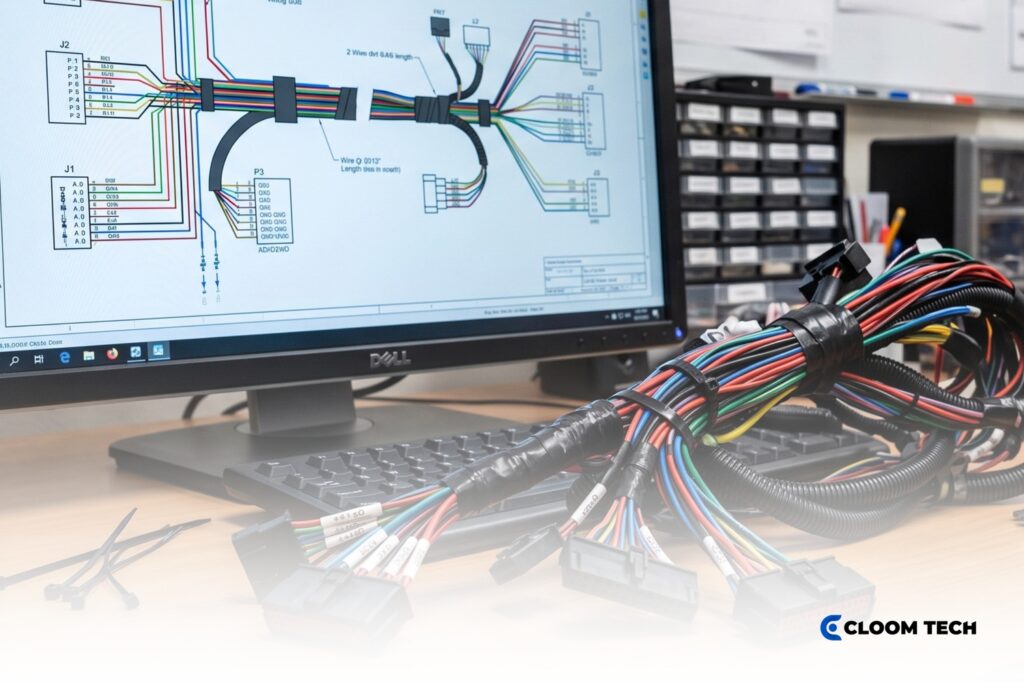
When an existing wire harness design returns a higher quote than expected, the cause often sits within choices made during product development. An oversized conductor, uncommon terminal, or complex branching can increase material use and assembly requirements.
Unnecessarily tight tolerances can also add measurement and inspection work. Incomplete drawings and bills of materials may also introduce pricing assumptions—unresolved production details need to be priced somehow, and assumptions rarely favor you.
A Design for Manufacturability (DFM) review examines your submitted drawing against practical manufacturing requirements before quoting. Each finding connects a specification to its cost effect, helping your team refine the drawing and protect required harness performance. The 10 mistakes below show where avoidable costs enter production and what you can adjust before submitting an updated request.
How a DFM Review Catches Cost-Driving Specification Choices
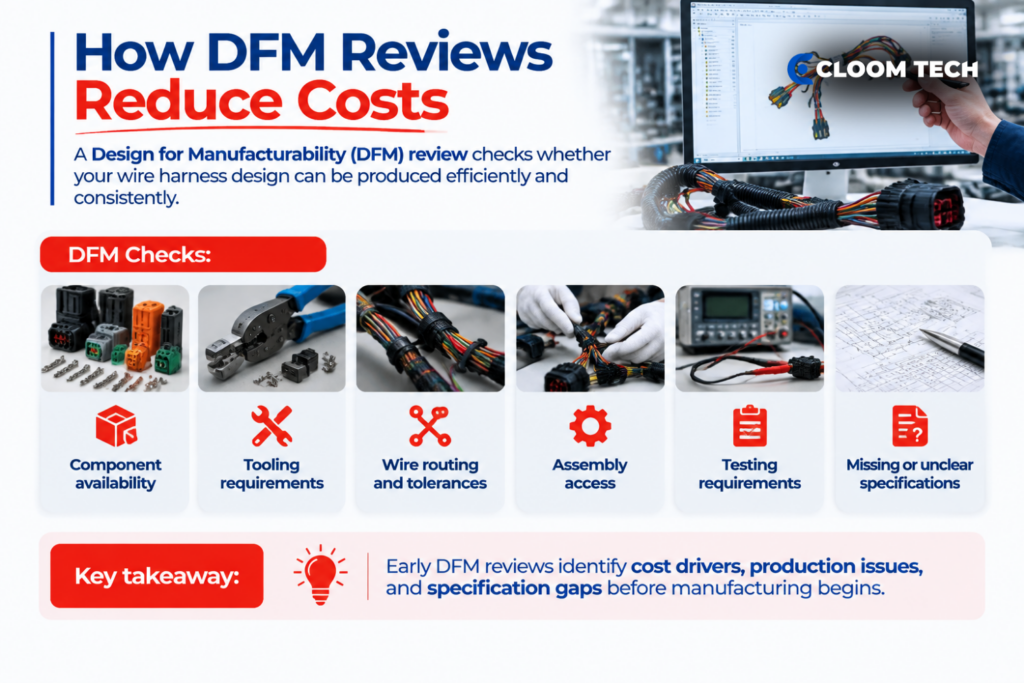
A DFM review evaluates how efficiently a manufacturer can build your approved wire harness design. The review covers component availability, tooling, routing, tolerances, assembly access, and test requirements before you commit to production.
DFM starts with drawings and specifications that your team has already created. Manufacturing specialists identify requirements that add cost, create ambiguity, or limit repeatability, then recommend practical alternatives for your approval.
Your team retains ownership of the product requirements. Cloom Tech limits its role to manufacturability feedback and recommendations based on your existing drawings. We don’t provide product research and development or ground-up engineering.
The review also provides a useful check on electrical wire harness design data exported from computer-aided design tools. A drawing may look complete on-screen while omitting tolerances, approved alternatives, or assembly details needed for reliable pricing. Reviewing those details early helps the manufacturer calculate materials, labor, and setup requirements against one technical baseline.
10 Cost-Driving Mistakes in Existing Harness Drawings
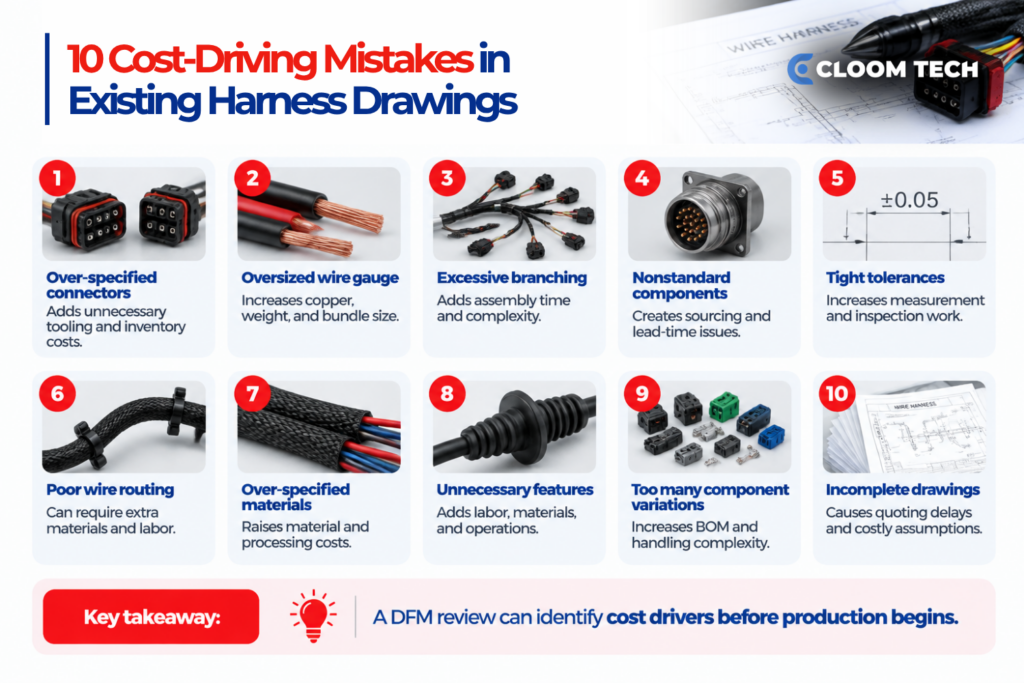
Each DFM finding affects a particular part of the quote. Connecting the specification to that cost mechanism shows where a controlled revision may improve manufacturability.
1. Over-specifying connectors and terminals
Connector requirements often exceed the conditions the completed harness will encounter. Sealing, mating-cycle capacity, retention features, or premium terminal families can remain in place after application requirements change.
Every specialized family can introduce additional inventory, inspection, and tooling requirements. Multiple variants may also reduce purchasing leverage and require more production changeovers.
Review the environment, current load, and connection frequency before approving each connector requirement. Where performance permits, consolidate families or approve qualified equivalents that maintain the required interface.
Record the required sealing, retention, and mating-cycle values so reviewers can distinguish functional requirements from inherited specifications.
2. Using a larger wire gauge than the application requires
Larger conductors use more copper per meter, increase bundle diameter, and add weight. They may also require larger terminals, seals, or processing equipment.
For automotive wire harness design, gauge decisions should reflect current, voltage drop, run length, ambient temperature, and bundling conditions. Choosing the smallest validated gauge controls copper consumption and preserves electrical performance.
A DFM reviewer can flag widespread oversizing, although your technical team must approve changes against calculated loads and applicable standards. Confirm terminal compatibility after every approved gauge change so that the conductor and insulation ranges suit the chosen contact.
3. Adding excessive branch complexity
Every branch changes the harness topology and adds handling. Operators must separate conductors, follow the specified route, and apply protection at defined positions.
Complex branching can require longer assembly times and specialized fixtures, even when the total conductor count remains unchanged. Closely grouped breakouts may also make the assembly sequence harder to standardize.
Review whether nearby destinations can share a practical route or whether branch points can be moved to more accessible locations. Show each breakout position, branch length, and covering transition directly on the released drawing.
4. Choosing nonstandard components without a clear need
A technically suitable component can create a costly sourcing path when it requires uncommon tooling, limited supplier availability, or high minimum purchase quantities. Long procurement windows may also extend the quoted lead time when distributors lack stock or require scheduled factory orders.
Component availability forms part of a practical DFM review before production. Reviewers compare specified part numbers with available tooling, approved materials, and forecast quantities.
When the application allows alternatives, list qualified options that simplify operator training and reduce changeovers among related harness assemblies. Define the controlling performance attributes for every alternative instead of relying on a broad equivalency note.
5. Leaving too little tolerance for assembly
Use narrow tolerances where dimensional control protects fit or function. Applying the same limits to every wire length adds measurement and inspection work where wider tolerances would still support installation.
Overly strict drawing tolerances can require individual verification during production. Short routing allowances may also leave insufficient room for termination placement.
Define precise dimensions around fixed interfaces, then use practical production tolerances elsewhere. A DFM review can identify where wider limits support efficient wire processing while preserving fit, connection access, and harness performance.
Mark datum points clearly so production teams measure every controlled length from the same reference.
6. Failing to account for practical wire routing
Routing controls wire length, branch position, bend radius, and the protection needed around installed surfaces. A two-dimensional path can underestimate the material and handling required inside the equipment.
Effective automotive wire harness design accounts for heat, vibration, moving components, service access, and abrasion along the installed route. Sharp bends, crowded pass-throughs, or unsupported spans may require additional sleeves, grommets, or retention points.
Confirming routing and bend-radius requirements helps the manufacturer quote those features accurately. Physical prototype checks can verify routing, fit, clearances, and assembly practicality. Relevant application or environmental testing can then evaluate performance under expected operating conditions.
Record clamp positions, pass-through dimensions, and connector exit directions when those details control the installed path.
7. Specifying materials without considering manufacturing impact
Insulation, shielding, and protective coverings affect application performance and processing. Premium materials may also require specialized stripping methods or additional termination preparation.
Material selection should match temperature, chemical exposure, abrasion, and movement requirements in each harness area. Higher-specification insulation and shielding increase costs when installed conditions don’t require those properties.
Assign material requirements by installed zone so advanced materials remain focused on locations that need their performance. Include the applicable temperature range, exposure conditions, and compliance requirements beside each material specification.
8. Including features that add labor without a clear functional need
Labels, sleeves, seals, ties, coverings, and secondary operations each add material and operator actions. Those requirements accumulate throughout the approved production quantity.
Added protection should address a defined environmental, mechanical, or identification requirement. Braiding, tubing, and molded protection increase material use and installation work.
Review every feature against its purpose, installed location, and acceptance requirement. Use clear spacing and placement notes so operators can position each retained feature consistently during production.
Specify label content and orientation wherever installation or maintenance depends on immediate identification.
9. Carrying more components or part variations than the application requires
Each connector, terminal, splice, and protective item adds purchasing, receiving, handling, and verification work. Every item also expands the bill of materials (BOM).
More circuits and terminations increase BOM content and assembly work. Review the function of every circuit and connection before release, then consolidate equivalent components where technical requirements permit.
Document each approved component and alternative so production teams can distinguish similar parts during assembly and inspection. Use consistent descriptions and manufacturer part numbers throughout the BOM, drawing, and inspection criteria.
10. Sending incomplete or unclear manufacturing information
An incomplete drawing package prevents accurate wire harness quoting because the manufacturer must identify gaps, request clarifications that delay your project timeline, or make pricing assumptions. Conflicting revisions create the same problem when teams work from different files.
Your package should define dimensions, tolerances, conductor details, pinouts, and approved part numbers. It should also cover material specifications, testing requirements, and forecast quantities.
Wire harness design software may generate BOMs and manufacturing documentation, although exported files still require review. Clear technical documentation and routing information reduce clarification cycles and manual BOM recreation. Revision identifiers should match throughout drawings, bills of materials, and test requirements before submission.
Identify required deliverables and file formats so every manufacturer prices the same scope of documentation.
How to avoid these costs before requesting a quote
A focused pre-submission review helps your team resolve cost-driving choices while revisions are still manageable. Reviewing the factors behind wire harness costs can help connect each specification to its effect on the quote.
Use these best practices before releasing the request for quotation (RFQ):
- Confirm the application requirements: Check electrical loads, environmental exposure, routing constraints, and acceptance criteria against the latest performance requirements.
- Review the component strategy: Verify connector families, conductor gauges, materials, and protection features, then document approved alternatives.
- Check drawing completeness: Include dimensions, tolerances, pinouts, branch locations, test criteria, and matching revision identifiers.
- Align quantity and timing: Provide prototype needs, forecast production volumes, and the required lead time so manufacturers can allocate fixed costs accurately.
- Request manufacturability feedback: Ask the manufacturer to review your existing specification and explain how each proposed change affects cost or processing.
For teams using electrical wire harness design platforms, the released output should connect schematics, drawings, and the BOM. Understanding the wire harness manufacturing process can help your team prepare information for each production stage.
Wire harness design software simplifies document generation, but controlled review remains necessary before quoting. If your team uses wire harness design services, complete and approve that work before requesting a manufacturing review. Submit one authorized technical baseline so the manufacturer can evaluate confirmed requirements during quoting.
Get a clearer quote from Cloom Tech
A higher quote often reflects specifications that add material, tooling, or assembly work without improving the application. Cloom Tech reviews your existing drawings and provides DFM feedback before manufacturing begins.
Our team can flag costly component choices, production constraints, and unclear requirements while keeping each recommendation aligned with your approved performance needs. We manufacture customized wire harnesses and cable assemblies from customer-supplied drawings across automotive, industrial, and commercial programs—so our feedback is grounded in what actually affects production cost and repeatability, not general advice.
Have an existing wire harness drawing ready for review? Contact us here for a DFM review.
10 Wire Harness Design Mistakes FAQs
Why can two manufacturers quote different prices for the same harness?
Manufacturers may calculate sourcing, setup, testing, packaging, and delivery costs differently, even when each receives the same technical package. Ask each manufacturer to identify assumptions and separate recurring unit charges from one-time expenses. Matching quantities, delivery terms, and acceptance requirements creates a consistent basis for comparing responses.
How long should a wire harness quote remain valid?
A quote should state its validity period because component prices, availability, and transportation costs may change after the manufacturer calculates the original offer. Confirm the validity date and request updated pricing before issuing a purchase order outside that period. This check helps your procurement team work with current commercial terms.
Do tooling charges apply to every production order?
Tooling charges may cover applicators, fixtures, or test equipment required for a specific harness, although the charging structure depends on the project. Ask whether each charge is recurring, quantity-dependent, or reusable for later orders. Written ownership and data maintenance terms clarify how the tooling will support future production.
How do drawing revisions affect an existing wire harness quote?
A drawing revision may change material quantities, component sourcing, tooling needs, testing steps, or assembly time. Send the updated drawing with a clear revision identifier and change record. The manufacturer can then reprice the affected requirements and preserve an accurate commercial history.
Back to Top: 10 Wire Harness Design Mistakes That Inflate Your Quote