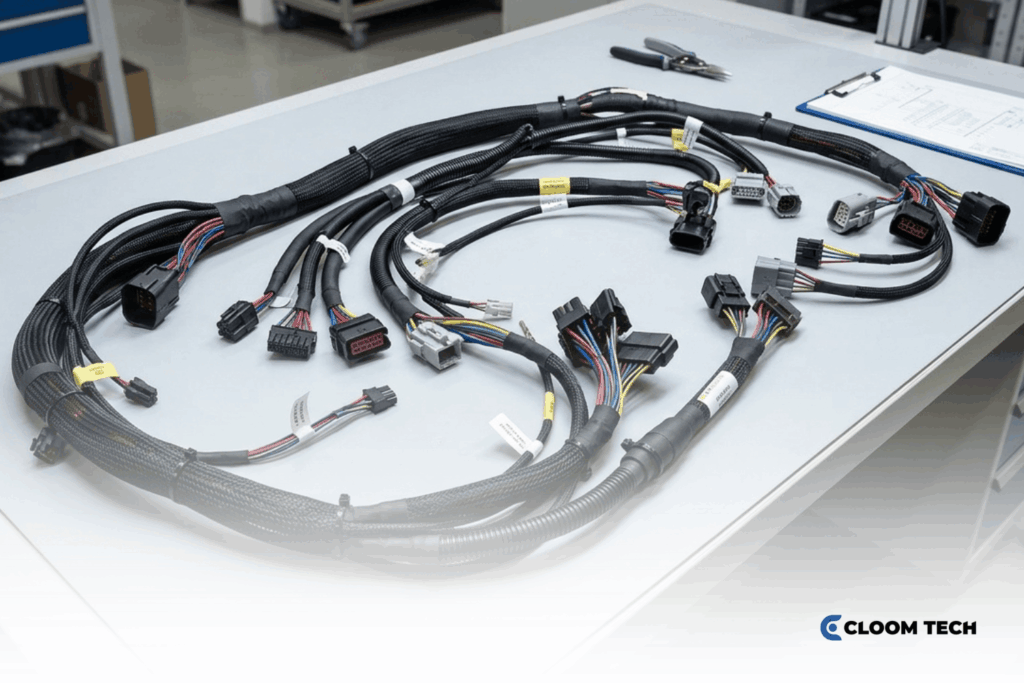
Choosing between a Yazaki wire harness program and an independent manufacturer starts with the production support your application actually needs. For original equipment manufacturers (OEMs), the right supplier depends on the assembly scope and the commercial commitments behind each quotation.
A vehicle program with sequenced deliveries has very different purchasing requirements from a prototype order for specialized equipment. Before choosing a manufacturing partner, establish how each supplier will handle your initial build and later revisions. Then compare the proposed production arrangement against your expected demand and the documentation your approval process requires.
Who is Yazaki?
Yazaki Corporation is a privately held Japanese group that manufactures automotive wire harnesses and the components inside them. Its history dates to 1929, when its founder began selling automotive wiring harnesses. The company was formally established in 1941.
Yazaki develops materials and manufactures finished harnesses, including the wire and connection components used in those assemblies. Its international manufacturing operations supply vehicle producers worldwide, placing Yazaki as one of the largest wire harness manufacturers. Its harness and component products cover several areas:
- Vehicle electrical systems: Automotive harnesses connect electrical devices throughout the vehicle, with configurations that reflect the equipment installed in each build.
- Electrified vehicles: High-voltage harnesses connect the battery with drivetrain equipment and other components that need higher operating voltages.
- Connection components: Yazaki connectors provide mating interfaces within wiring systems, alongside the group’s wire products and complete harness assemblies.
- Specialized equipment: Yazaki also produces cabling for agricultural machinery and industrial equipment, with applications extending to home appliances.
How Does Yazaki Wire Harness Supply Compare with Independent Manufacturing?
Yazaki’s integrated production is built to coordinate harness manufacturing with vehicle assembly. Independent manufacturers, by contrast, offer capabilities that vary with their equipment and processes. Your comparison should clarify which production responsibilities each supplier can take on and how well they match your needs.
High-Volume Programs and Long-Term Commitments
Large Tier-1 suppliers support high-volume vehicle programs through sustained manufacturing capacity and deliveries coordinated with the customer’s production schedule. Long-term supply agreements define those obligations over an agreed period, with specific commitments negotiated for each program.
This structure suits automotive programs well, but it can feel heavy for an OEM ordering a few hundred harnesses a year. Before entering a long-term production agreement, establish how the proposed terms handle these program requirements:
- Volume commitments: Confirm the capacity available for your program and separate planning forecasts from quantities you’re contractually committed to buy.
- Supply duration: Establish the agreement’s duration, and clarify whether it includes service-part supply after the main production program ends.
- Demand changes: Agree on the notice required for revised quantities and how both parties will approve extra capacity or material commitments.
- Production changes: Specify which component substitutions or manufacturing changes need your approval, including any validation before revised assemblies enter production.
Vehicle-Specific Production and Standalone Orders
Yazaki’s customer-specific wiring harness system handles equipment differences between individual vehicles in a production program, rather than building identical harnesses for every vehicle. Known as KSK, from the German Kundenspezifischer Kabelsatz, the system supports single-unit production with traceability and just-in-sequence delivery.
Single-unit output within an established vehicle program doesn’t mean Yazaki will accept an unrelated one-piece prototype order. Likewise, an independent manufacturer’s willingness to take small orders still needs confirming against the components and manufacturing work your assembly requires. That gap between program-scale production and standalone builds is where a specialized manufacturer typically fits best.
The table below summarizes where each type of supplier typically fits:
| Purchasing Factor | Large Tier-1 Supplier, Such as Yazaki | Specialized Independent Manufacturer |
|---|---|---|
| Program fit | Built around high-volume vehicle programs and long-term supply agreements | Suited to prototypes, low-to-mid volumes, and specialized equipment |
| Minimum order quantity | Volumes tied to program commitments; confirm whether small standalone orders are accepted | Often open to single prototypes and small production batches |
| Sample lead time | Scheduled around program milestones and sequenced vehicle deliveries | Often faster for standalone samples; Cloom Tech quotes 3–4 weeks |
| Component sourcing | In-house component manufacturing forms part of integrated harness operations | Confirm access to the specified parts and who verifies purchased components |
| Technical access | Establish which development and integration activities the agreement includes | Confirm direct access to the technical and production team giving manufacturing feedback |
| Quotation basis | Request the charges tied to the proposed program and its delivery arrangements | Request itemized manufacturing charges and quantity breaks for the specified assembly |
| Supplier suitability | Assess the proposed production organization against your vehicle-program needs | Verify that available equipment and inspection processes can support your assembly |
How Should You Evaluate a Supplier for Your Program?
In practice, a Tier-1 supplier is usually the better fit when your program runs at automotive volumes, with long-term contracts and sequenced deliveries. A specialized manufacturer tends to suit lower volumes, frequent revisions, specialized equipment, or programs that need prototypes quickly and pricing broken down line by line.
Buyers often assume the largest supplier is the safest choice. In practice, the safest choice is the supplier whose processes, minimums, and communication match your program’s real volumes and revision rate.
Whichever route you take, evaluate suppliers against one controlled drawing revision and a common set of acceptance requirements before comparing quotes. Consistent inputs show you the real differences in the work included and the evidence each supplier will provide.
Separate Prototype Quantities from Production Minimums
Quote the initial evaluation build separately from later production, because each stage can have different purchasing and component requirements. For eight evaluation assemblies, for example, ask whether the supplier needs to buy more material than those samples actually use.
At Cloom Tech, minimum order quantities (MOQs) depend on the assembly, and we confirm final quantities for each quote. As a general guide:
- Prototypes: Most customized orders have no fixed MOQ, so a project can start with a single prototype and scale to full production.
- Prototype batches: For specialized assemblies, you can usually order prototypes in batches as small as 5–10 units. Some cable assembly categories start at around 50 pieces.
- Production orders: Once a project moves into regular production runs, typical MOQs range from 100 to 500 units. The exact figure depends on the complexity of the cable assembly or wire harness.
When assessing low-volume wire harness manufacturing, also ask who owns unused materials and how the supplier will handle inventory if your forecast changes.
Verify the Starting Conditions Behind Lead Times
Assess lead times against material readiness and approval milestones, since a quoted duration needs a defined starting point. At Cloom Tech, samples take 3–4 weeks and mass production takes 4–5 weeks.
Your schedule also needs time for sample evaluation and transport, with responsibilities agreed before you place the order. Request these details to check whether a supplier’s dates support your required receiving date:
- Material availability: Identify components the supplier must purchase before production can begin, and request expected availability dates.
- Sample acceptance: Name the person responsible for approval and document the checks they must complete before releasing the production order.
- Delivery endpoint: Confirm whether the quoted completion date means factory readiness or receipt at your nominated delivery location.
- Schedule dependencies: Ask which open drawing questions could delay production, and agree on a response timeline.
Define the Limits of Manufacturing Feedback
Manufacturing feedback should address how to produce your existing assembly while preserving the application requirements set in your drawings. At Cloom Tech, our DFM feedback works from your existing drawings, and your team retains full responsibility for product development.
Ask the technical and production team to explain each recommendation in terms of the manufacturing issue it solves. This matters most when a recommendation touches a part your customer has already validated, since even a cost-saving change can trigger requalification:
- Material selection: Request the exact proposed component and check its suitability against the operating requirements already defined for the assembly.
- Cost reduction: Ask which manufacturing or material cost the recommendation changes and whether implementing it needs additional qualification work.
- Production efficiency: Ask which assembly step changes and what updates the manufacturing documentation will need.
Examine Quality Evidence and Quotation Scope
Assess a supplier’s quality credentials alongside the inspection requirements for your assembly, including the records supplied with the completed order. Cloom Tech holds ISO 9001 and International Automotive Task Force (IATF) 16949 certifications. Our ISO 13485 certification applies specifically to wiring harness and cable assembly manufacturing, including assemblies for medical applications.
We also work to IPC/WHMA-A-620, the cable and harness workmanship acceptance criteria from IPC and the Wiring Harness Manufacturers Association. Confirm the workmanship class and acceptance requirements for your order, rather than treating any credential as approval of a particular assembly. Check these points against the documentation your purchasing team needs:
- Electrical inspection: Ask the manufacturer to specify the planned electrical checks and the results supplied with the completed order.
- Revision identification: Establish how the supplier will link delivered assemblies to the approved drawing revision and acceptance requirements.
- Nonrecurring costs: Separate tooling and setup charges from the unit price, with clear treatment of those costs on repeat orders.
- Production accountability: Clarify the relationship between the supplier you are contracting with and the actual manufacturing entity, so you know who controls the build and handles manufacturing discrepancies.
Discuss Your Wire Harness Requirements with Cloom Tech
Cloom Tech manufactures customized wire harnesses from your existing drawings, from first prototypes through to production. With direct access to our technical and production team, you can discuss material selection and manufacturing requirements before approving the build.
For your supplier comparison, we’ll assess your requested quantities and provide a quote with every fee clearly itemized. Whether you need five prototypes or a recurring production order, your quote will confirm MOQ, lead time, and pricing before you commit. Send us your drawings and order requirements to get a free quote.
Yazaki vs. Independent Wire Harness Manufacturers FAQs
Does a Yazaki connector identify the harness manufacturer?
No, a Yazaki connector identifies the component brand, but another manufacturer may have built the finished harness. Check the assembly label and production documentation to confirm who manufactured the harness and which part number and revision apply. This matters most when you’re sourcing a replacement or repeat order.
Can Cloom Tech supply connectors separately?
No, Cloom Tech supplies connectors only within customized harnesses and cable assemblies, not as separate components. Include the required connector part numbers when you request a quote for the assembled product.
Does prototype approval authorize later component substitutions?
No, prototype approval covers the evaluated configuration only, and it doesn’t let the manufacturer substitute components in later production. Record the approved part numbers and drawing revision so future proposals reference the exact configuration your team accepted.
Can an independent manufacturer reproduce an existing harness?
Yes, provided there is sufficient technical documentation. The manufacturer needs drawings and specifications to confirm it can reproduce your assembly and meet the acceptance criteria. Submit what you have, then resolve any missing requirements before authorizing replacement production.
Back to Top: Yazaki vs. Independent Wire Harness Manufacturers: What OEM Buyers Should Know